If you want your PPM rollout to succeed, you need more than configuration. You need a structured change management plan that ensures adoption, builds trust, and embeds new ways of working across the organization.
Why Change Management Is Critical in Modern PPM
The global project portfolio management market is growing rapidly, from $6.9 billion in 2025 to over $13 billion by 2031, driven by hybrid work, stricter governance, and the rise of AI-powered decision-making and forecasting. PPM is no longer just a reporting layer but about orchestrating decisions at scale. And that level of transformation doesn't happen without deliberate change management.
What Is a Change Management Plan for a PPM Rollout?
A change management plan for a PPM rollout is a structured approach to:
- prepare stakeholders for new ways of working
- transition teams from fragmented tools to a unified system
- ensure sustained adoption of portfolio processes and technology
It goes beyond training or communication. It addresses how decisions are made, how work is visualized, and how teams collaborate across the organization. Without this layer, even the most advanced PPM platform becomes just another tool.
How to Map the Roles and Stakeholders?
A strong change management plan maps roles clearly:
- Executives set expectations and reinforce governance
- PMO/EPMO leaders own standards and rollout coordination
- Portfolio managers drive adoption at the portfolio level
- Team leads and delivery managers embed change into daily work
- End users maintain data and follow workflows
Executives define direction and PPM rollout success criteria, but they are not the ones who struggle with day-to-day adoption. Adoption happens at the operational level, but it must be reinforced from the top.
What Are the Phases of a PPM Change Management Plan?
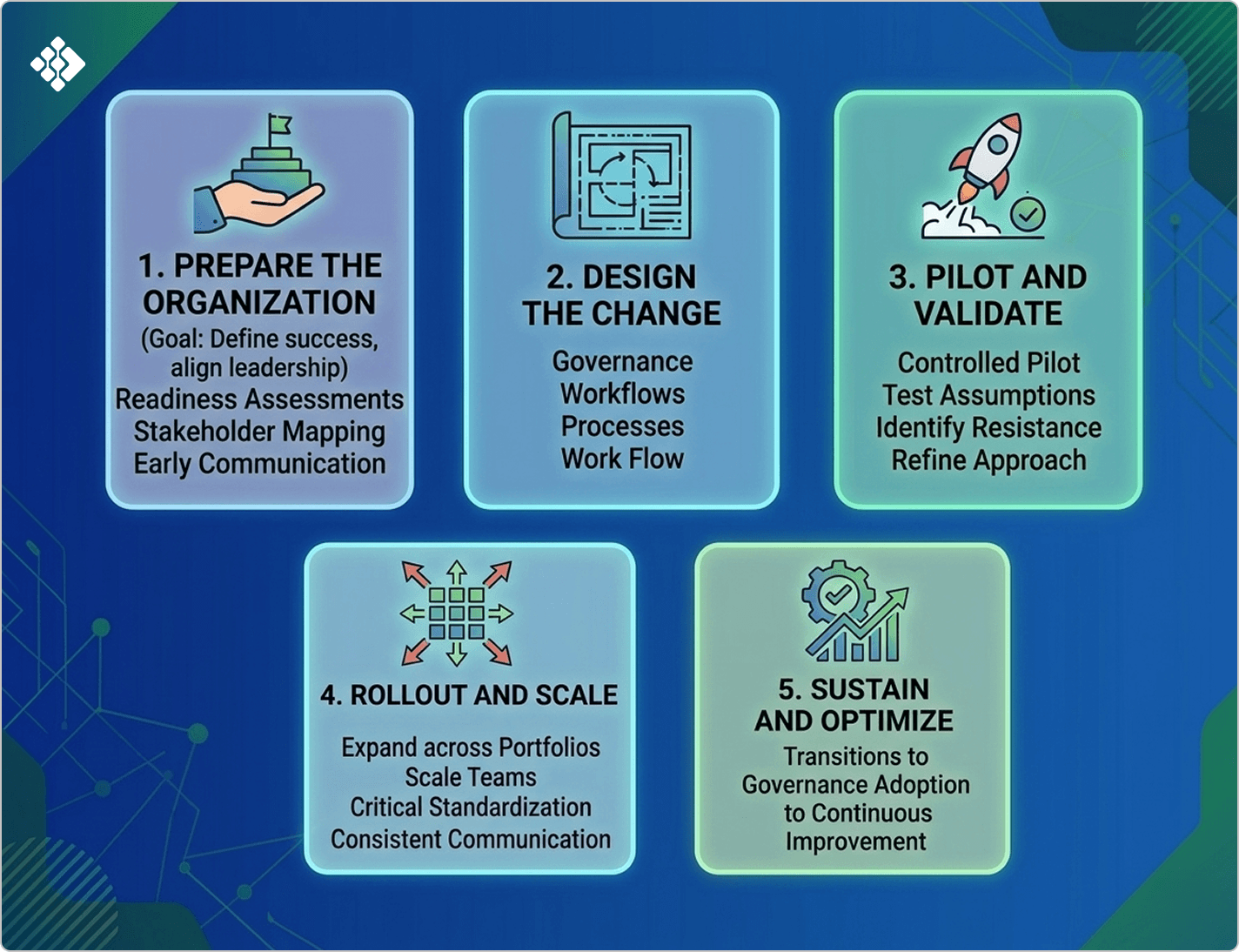
Successful PPM rollouts follow a predictable pattern.
Phase 1: Prepare the Organization
The goals of this phase are to define success and align leadership. It includes readiness assessments, stakeholder mapping, and early communication.
Phase 2: Design the Change
Governance, workflows, and processes are defined. This is where organizations decide how work should flow.
Phase 3: Pilot and Validate
A controlled PPM pilot allows teams to test assumptions, identify resistance, and refine the approach before scaling.
Phase 4: Rollout and Scale
The system expands across portfolios and teams. Standardization becomes critical, as does consistent communication.
Phase 5: Sustain and Optimize
Change management transitions into governance. The focus shifts from adoption to continuous improvement.
Visual cue: Add a 5-phase lifecycle diagram
How Detailed Should a Change Plan Be for a PPM Pilot?
A pilot requires clarity. Your plan should be detailed enough to define:
- roles and responsibilities
- core workflows
- success criteria and KPIs
At the same time, it must remain flexible. Pilots are learning environments, and rigid plans slow down adaptation.
Balance Process Change vs. Technology Change
One of the most common challenges in PPM rollouts is focusing too heavily on technology. Process defines how work flows, while technology enables visibility and execution. Both must evolve together.
This is where a flexible platform becomes critical. A change-ready PPM system like Businessmap allows organizations to adapt workflows dynamically, rather than forcing rigid structures from the start.
Which Capabilities to Roll Out First?
Start with capabilities that deliver immediate clarity, create quick wins, and build trust:
- portfolio visibility
- standardized reporting
- basic workflow structure
More advanced capabilities like automation, predictive analytics, or deep integrations should come later, once adoption is stable.
How to Handle Resistance and Change Fatigue
Most resistance comes from perceived effort. Teams feel they are being asked to do more work without immediate benefit. To overcome this, the change must remove friction, not add it.
Successful strategies include:
- demonstrating quick wins
- reducing manual effort through automation
- embedding new processes into existing routines
- using internal champions to model behavior
People don't resist change; they resist unnecessary effort.
Use a Change-Ready PPM Platform to Reduce Friction
Technology alone doesn't drive change, but the wrong technology can block it.
A change-ready PPM platform should:
- connect strategy to execution
- provide real-time portfolio visibility
- support flexible workflows
- reduce manual reporting effort
Businessmap enables organizations to visualize work across all levels - from strategic initiatives to team execution, while maintaining adaptability. This flexibility is essential during rollout, when processes are still evolving.
When the platform supports change instead of constraining it, adoption becomes significantly easier.
Businessmap has become a cornerstone of our transformation toward a connected, end-to-end value delivery system. As a leader responsible for modernizing ways of working across IT and business functions, I've evaluated many tools that claim to align strategy, execution and value delivery. Businessmap is the first platform that genuinely supports this alignment in a practical, scalable, and flexible way.
Source: Gartner Peer Insights
How to Measure Adoption and Readiness During the Rollout?
Adoption is the leading indicator of success. Before ROI appears, you should see changes in behavior.
Key signals include:
- increasing system usage across teams
- reduced reliance on Excel or parallel tools
- improved trust in portfolio data
- faster decision-making cycles
These indicators show whether the organization is moving toward a single source of truth.
How to Adjust the Plan Mid-Rollout?
If adoption is low, simplify workflows. Reduce required inputs and focus on what matters most.
If resistance is high, revisit communication. Ensure stakeholders understand the value, not just the process.
If engagement from leadership is weak, reinforce accountability. Adoption follows behavior at the top.
The key principle is adaptability. A rigid plan slows down progress, while a responsive plan builds momentum.
How to Transition from Change Management to Ongoing Governance
The goal is to make new behaviors sustainable, not temporary. Change management evolves into governance, and that means:
- regular portfolio reviews
- defined data quality standards
- ongoing training and onboarding
- continuous improvement loops
PPM Change Management Plan Checklist
Before launching your rollout, ensure the following are in place:
If you're looking to connect strategy with execution, reduce manual reporting, and drive adoption across teams, it's worth seeing how a purpose-built platform works in practice.
Explore how Businessmap supports enterprise PPM and change-ready workflows.

Michaela Toneva
Kanban & Agile Practitioner | SEO & Content Creator
With a never-ending thirst for knowledge and a passion for continuous improvement, Michaela is an Agile practitioner with a good understanding of Kanban, Lean, and Agile methodologies. Her professional background includes SEO and content writing with a dose of sales and a pinch of social media.