Most PPM pilots don't fail because the tool is incorrect.
Instead, they fail when success is not clearly defined from the outset.
Organizations launch a pilot hoping to "improve visibility" or "align strategy," but when it's time to evaluate results, there's no agreement on what success actually looks like.
If you want your PPM pilot to lead to real transformation, not just another experiment, you need a clear framework for defining, measuring, and proving success.
This guide walks you through exactly that.
Why Most PPM Pilots Fail to Prove Value
A PPM pilot is supposed to answer one question: "Should we scale this across the organization?"
But in practice, most pilots never reach a clear answer.
The root cause is often a focus on tool capabilities rather than business outcomes. They configure dashboards, import data, and run reports, but they don't define what decisions should improve as a result.
In reality, teams spend days each month compiling reports manually. When a PPM tool is introduced, the expectation is to have "more data." What leadership actually needs is faster, clearer decisions.
Define What "Success" Means Before You Start
Before selecting tools or configuring workflows, you need to answer one question: What is this pilot supposed to prove?
In practice, most PPM pilots fall into three categories:
- Proving ROI: Can we reduce costs, cycle time, or inefficiencies?
- Proving process: Can we standardize governance and workflows?
- Proving adoption: Will teams actually use the system?
High-performing organizations pick one primary objective, then support it with one or two secondary goals. For example, you might focus on reducing reporting time (primary), while also tracking adoption (secondary).
Clarity here simplifies everything that follows - especially KPI selection and stakeholder alignment.
How PPM Success Differs from Project-Level Success
Project success and PPM success are not the same. One of the biggest misconceptions in PPM pilots is measuring the wrong thing.
A project can succeed and still be a poor investment. PPM success focuses on portfolio-level outcomes, in other words, whether the organization is working on the right things and allocating resources effectively.
Without this shift, your pilot will measure execution efficiency but miss strategic impact.
Critical Success Factors for a PPM Pilot
Across industries, successful PPM pilots share a consistent set of foundations.
- Executive sponsorship. Leaders need to use the system to make decisions, not just review reports.
- Governance must be defined. Without clear rules for prioritization, approval, and review, even the best tools become passive dashboards.
- Data must be standardized. Inconsistent project definitions, ownership fields, or status updates will quickly undermine trust in the system.
- Transparency is equally important. Excel-based tracking can create fragmented visibility and slow reporting cycles. Highly visual workflows allow teams to understand dependencies and progress in real time, improving coordination.
- Adoption matters more than features. A system that no one uses is worse than no system at all.
How to Design Success Criteria for a PPM Pilot
Designing success criteria requires discipline.
- Start with the business problem. For example, slow reporting cycles or poor prioritization.
- Then define measurable outcomes. If reporting is the issue, your target might be reducing report preparation time from several days to a few hours.
- Next, map those outcomes to KPIs. Reporting cycle time becomes a measurable indicator. Visibility coverage - how many projects are tracked in one system - becomes another.
- Finally, define success thresholds. What constitutes success? A 30% improvement? 50%? This step is often skipped, but it's the most important one. Without clear thresholds, your pilot has no pass/fail criteria.
What KPIs Should You Track in a PPM Pilot?
Choosing the right KPIs determines whether your pilot is clear on its goals.
- Adoption. If teams are not actively using the system, nothing else matters. Track how many users engage regularly and how frequently data is updated.
- Visibility. A strong signal of success is the ability to answer portfolio-level questions instantly.
- Efficiency metrics. In many organizations, reporting consumes significant time. Reducing that burden is both measurable and highly visible. Eliminating that inefficiency can be a clear success indicator.
- Strategic KPIs. These include alignment between initiatives and business goals, as well as improvements in delivery speed. For example, one organization reduced product development time by nearly 30% after implementing connected workflows.
How to Define and Track Strategic Alignment
In practical terms, strategic alignment means ensuring that every piece of work contributes to a measurable business objective.
During a PPM pilot, you can track this by measuring:
- the percentage of projects linked to strategic initiatives
- visibility into goal progress
- dependencies across teams contributing to shared outcomes
This is where connected systems make a difference.
For example, in Businessmap, strategic goals can be visualized and broken down into initiatives that link directly to team-level work. This allows leaders to track whether execution is actually driving results, not just activity.
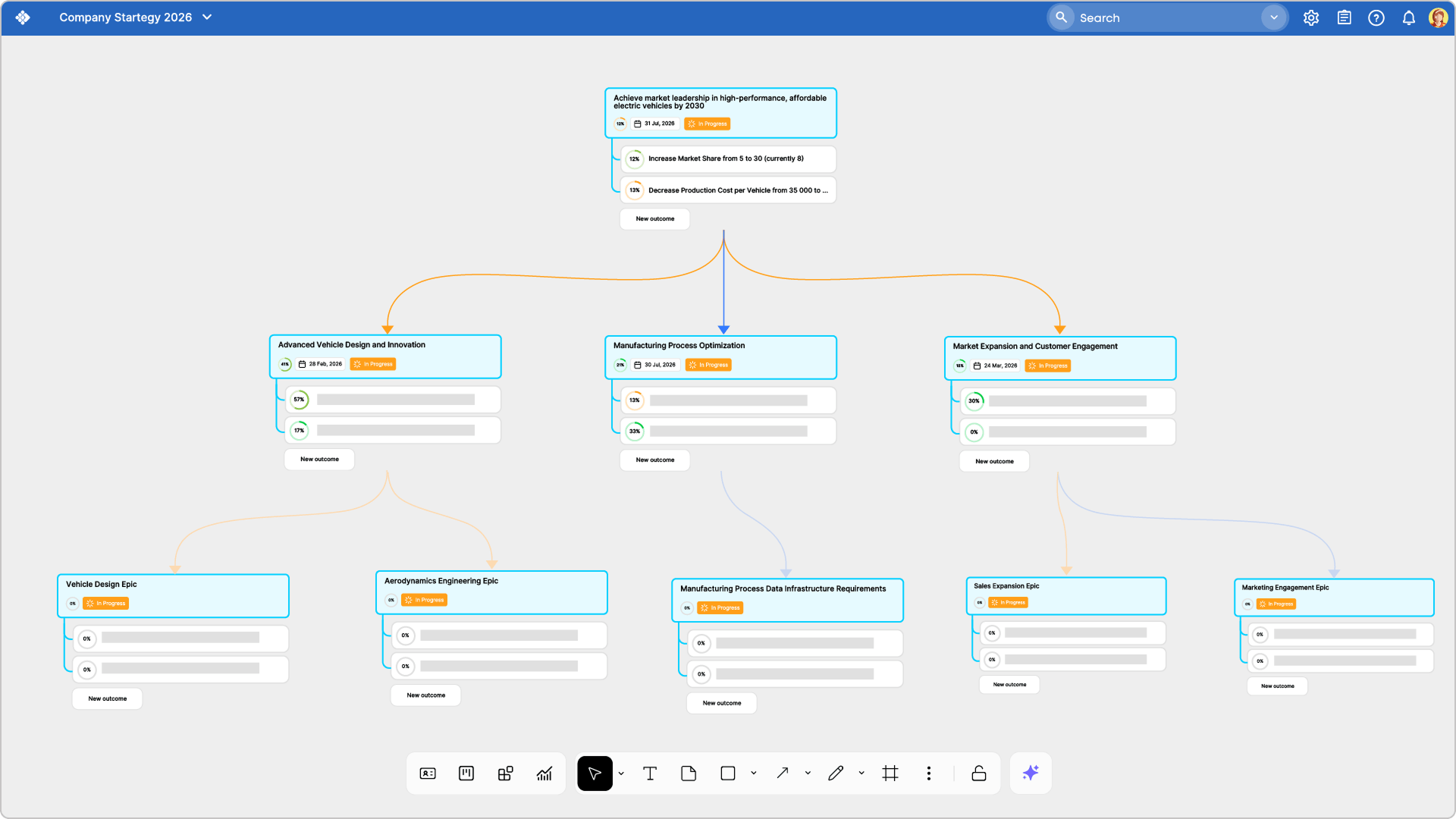 Visualizing the strategic goals, portfolio, and project-level initiatives using the AI Canvas board in Businessmap
How to Choose the Right PPM Tool Based on Success Criteria
Instead of focusing on feature lists, evaluate tools based on your success criteria.
If your goal is visibility, the tool must provide real-time portfolio views. If your goal is alignment, it must connect strategy to execution. If adoption is critical, usability and flexibility become priorities.
Platforms like Businessmap are designed to connect planning, execution, and reporting into a single system, so success metrics are not just tracked but embedded into how work flows.
Businessmap is an online platform to manage the portfolio, the operative works and the customer ticketing, offering a full traceability from the corporate view to the task.
Source: Gartner Peer Insights
How to Decide the Right Scope for a PPM Pilot
The best approach to decide on the scope of a PPM pilot is to start with a representative slice of the organization, typically one department or portfolio that includes cross-team dependencies. The goal is to prove something meaningful.
In one engineering environment, the pilot began with a single team before scaling across divisions. This allowed the organization to refine workflows and build confidence before expanding. Using the Businessmap project and portfolio platform, the team created a structured visual workspace that mapped their work breakdown structure, project stages, and daily activities in one place. Over time, they extended this into multiple interconnected workflows, covering long-term projects, mid-sized service work, and day-to-day operations, each with clear policies and dependencies.
What made this approach effective was not just the limited scope, but the intentional inclusion of complexity. The pilot environment reflected real conditions while remaining contained enough to iterate quickly. This balance enabled the organization to validate not only the tool, but the underlying operating model. Read the Full Businessmap Case Study
A well-scoped pilot should therefore meet three criteria:
- It represents real portfolio challenges
- It includes enough stakeholders to validate collaboration and governance
- It remains small enough to adapt quickly based on feedback
Signs Your PPM Pilot Is Failing
Warning signs include:
- low user adoption
- continued reliance on Excel or parallel tools
- unclear or unused reports
- lack of executive engagement
- no improvement in decision-making speed
These signals don't mean you should abandon the initiative. Often, they indicate the need to re-scope, simplify, or refocus success criteria.
How to Present PPM Pilot Results to Executives
Translating pilot results into business impact is what executives care about.
Focus on:
- before vs. after comparisons
- time saved in reporting and decision-making
- improvements in visibility and alignment
- early indicators of ROI
Dashboards are more effective than presentations. Show real data, not summaries.
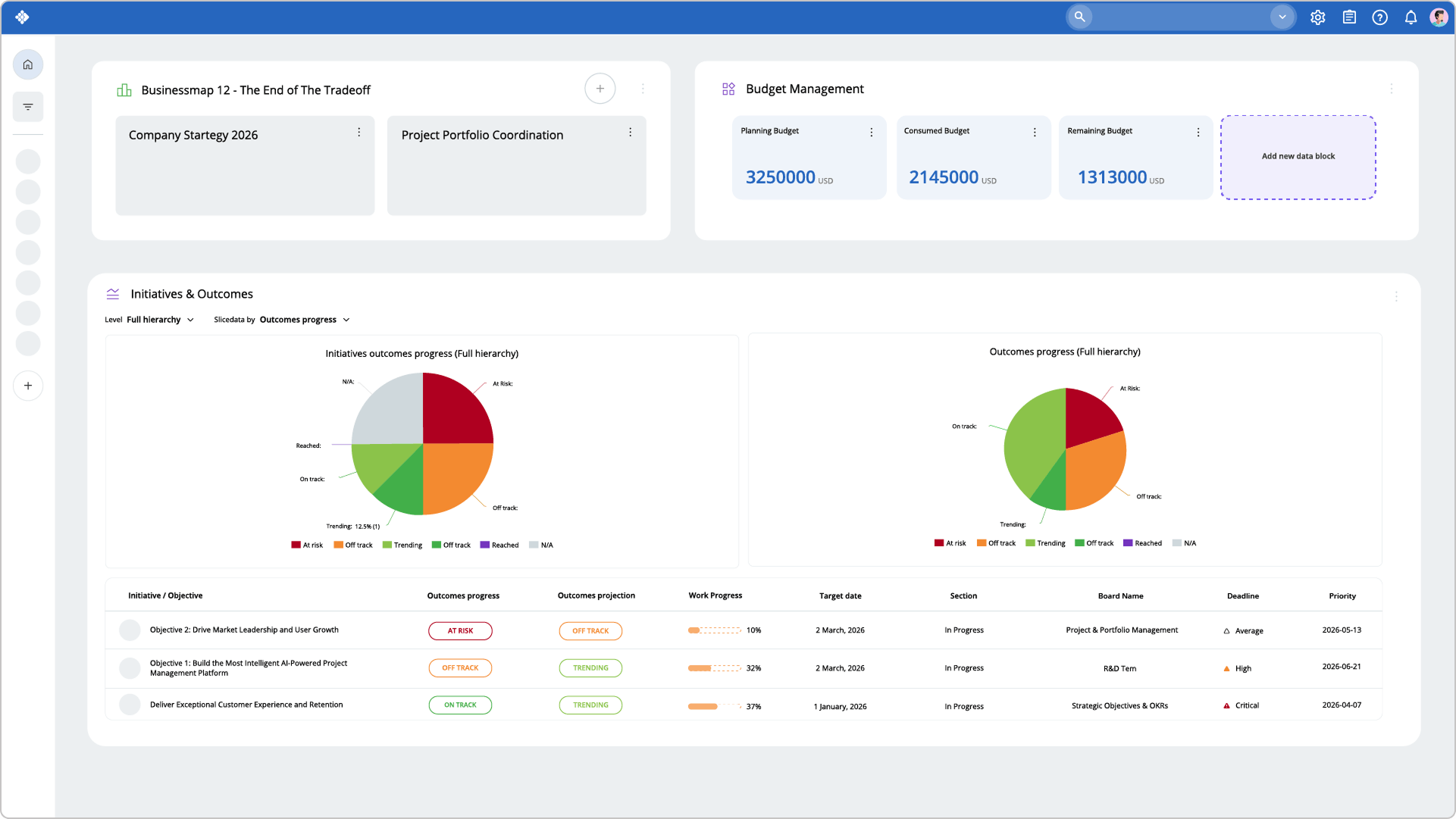 Visualizing strategic goals and progress using executive dashboards in Businessmap
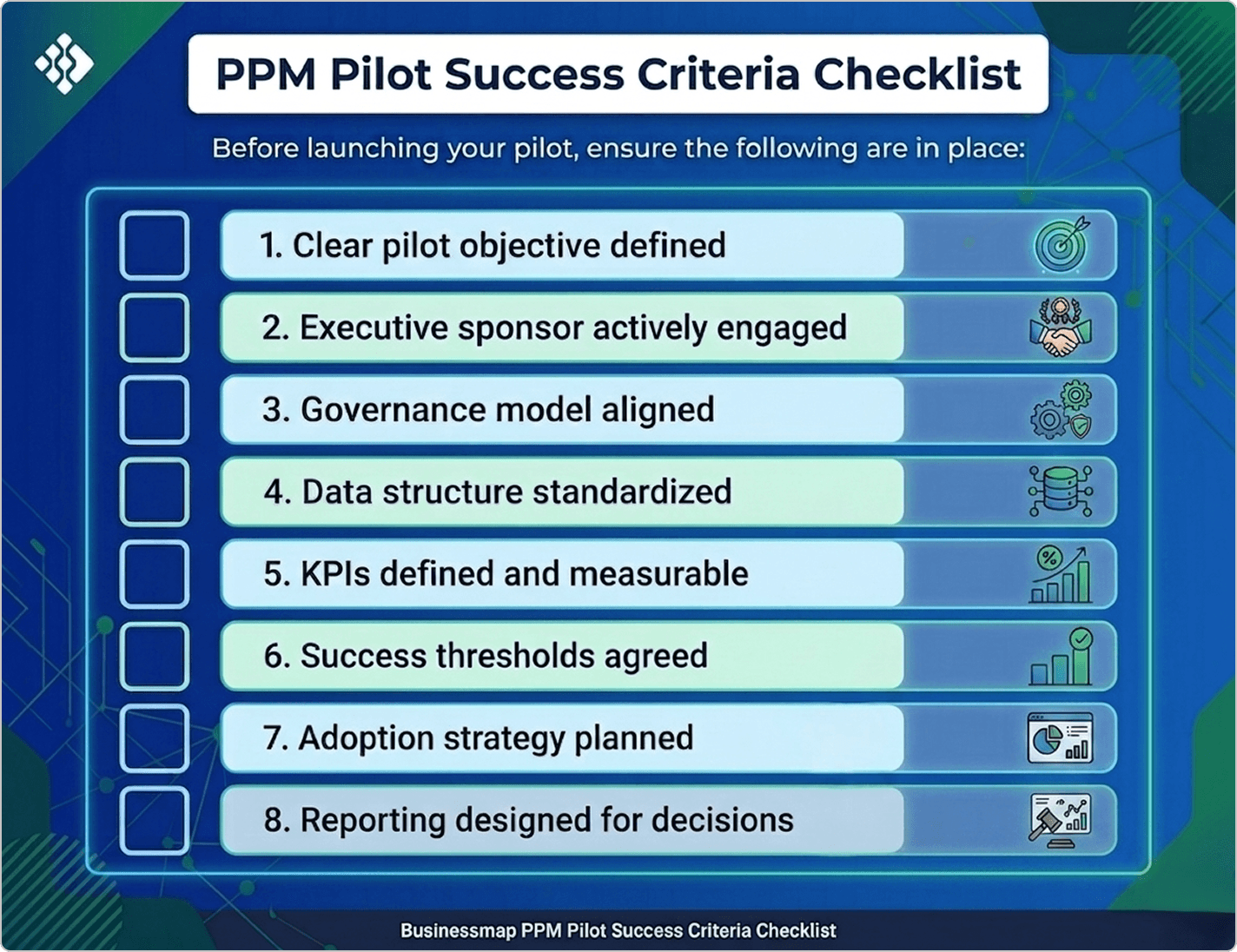
PPM Pilot Success Criteria Checklist
Before launching your pilot, ensure the following are in place:
- Clear pilot objective defined
- Executive sponsor actively engaged
- Governance model aligned
- Data structure standardized
- KPIs defined and measurable
- Success thresholds agreed
- Adoption strategy planned
- Reporting designed for decisions
From Pilot to Full-Scale PPM Implementation
A successful pilot is the beginning.
The transition to full-scale PPM implementation should build on what worked. Refine processes, expand scope gradually, and invest in training and adoption.
Once a pilot proves value, scaling becomes a business decision. It's about proving that your organization can make better decisions at scale.
See how Businessmap supports organizations operating at scale delivering portfolio visibility, resource planning, and execution in one place.

Iva Krasteva
Content Strategist | Agile Practitioner | Kanban Certified
Iva is a Kanban-certified Agile expert with hands-on experience in SEO, content creation, and Lean practices. She has published dozens of articles on Lean, Agile, and Kanban practical applications. Iva actively promotes collaborative, flexible work environments and regularly shares process optimization insights through writing.