Key Takeaways
- Agile project management is an iterative approach to managing projects that focuses on continuous value delivery and incorporating customer feedback with every iteration.
- There are 12 principles and 4 values that build the foundation of Agile project management.
- The 5 building blocks of the Agile process are: transparency, customer focus, adaptability, shared ownership, and continuous improvement.
- Among the most popular Agile project management frameworks and methods are Kanban, Scrum, and Scrumban.
What Is Agile Project Management?
Agile project management involves breaking down projects into smaller, iterative phases and continuously reassessing and adapting plans based on feedback and changing requirements. The goal is to deliver high-quality products or services quickly and efficiently while remaining responsive to customer needs and market trends.
There is also the common misconception that Agile is a methodology. Instead, Agile is a way of thinking for collaborative problem-solving and an approach people apply to modern-day project management.
Plan fast. Adapt faster. Deliver confidently.
A Brief History of Agile
It all started with the so-called "application development crisis" in the early 1990s. At the time, it could take three years or more to deliver a software product. By the time development finished, customer needs and technologies had often changed.
This problem led industry leaders to explore better ways to build software.
This is how it came about the now-famous gathering of 17 software development leaders at the Snowbird ski resort in the Wasatch mountains of Utah between 11-13 February 2001. The group met to talk about skiing and to relax generally. However, what eventually emerged was the "Agile Manifesto" that changed how we manage projects today.
What Are the 5 Pillars of Agile Project Management?
In the core of Agile project management lies the word "agility," which means "mobility, nimbleness," as well as from the Latin "agree:" "to do, to act." This signifies the ability to move something forward while remaining flexible enough to change direction when needed.
So, in terms of project management, "agility" has five essential attributes that form the building blocks of the Agile process:
- Transparency
- Customer focus
- Adaptability
- Sense of Ownership (Effective Leadership)
- Continuous Improvement
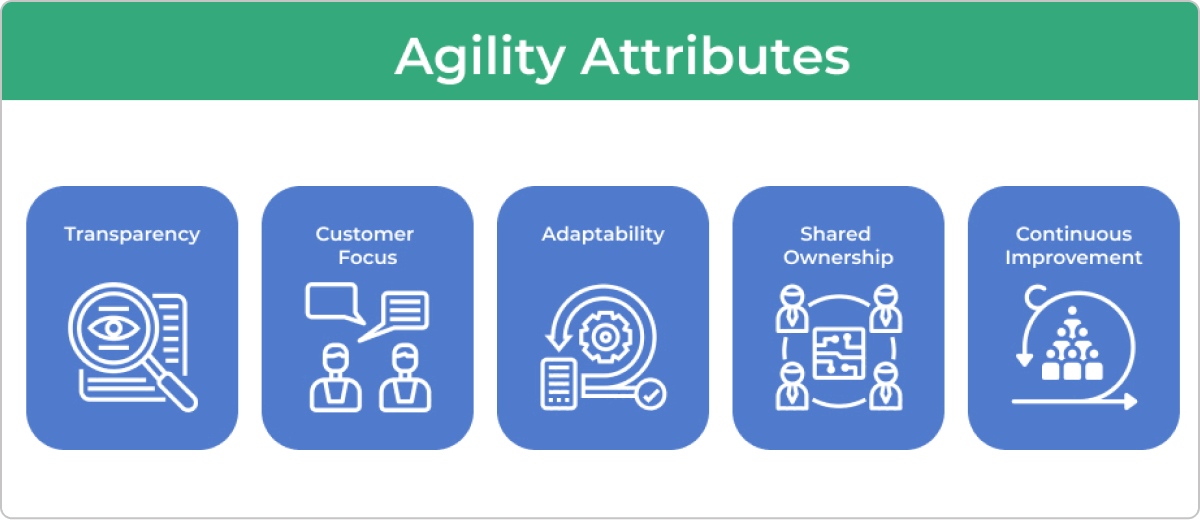
Combined, they are what makes a project Agile. To discuss them in more detail, let’s break down each one of them below:
1. Transparency
One of Agile project management's central themes is the shared understanding of the process and goals among everyone involved in the project.
In Agile environments, teams are encouraged to openly communicate progress and challenges of work, share their ideas without the pressure of being judged or criticized.
Visual tools such as Kanban boards help make work visible, so everyone can see what tasks are underway, how work flows through the process, resolve problems faster, and improve together.
Businessmap is the most flexible software
to gain full work visibility across teams & portfolios
2. Customer Focus
Agile organizations are heavily invested in gathering customer feedback and ensuring their requirements are well understood and met. Instead of focusing solely on delivering the predefined final product, Agile teams collaborate with customers throughout the project to ensure they build something that truly meets user needs.
That’s why frequent feedback loops in the Agile project delivery lifecycle serve as checkpoints where customers can see "what they thought they wanted" actually looks in practice. This helps teams to adjust quickly, align better with customer expectations, and avoid costly rework later in the project.
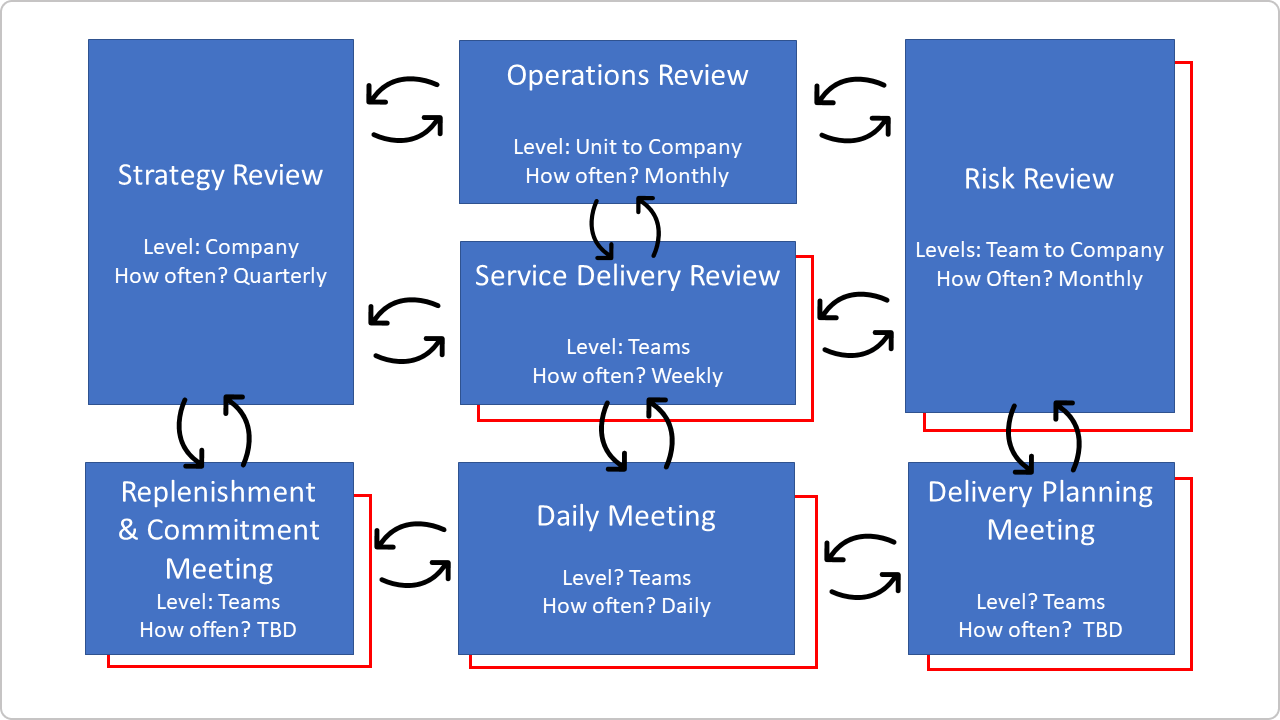 Feedback loops for improvement and collaboration
3. Adaptability
Adaptability – the other main idea of Agile is the ability of teams to respond more effectively to change through the checkpoints mentioned above. This also calls for more frequent value delivery to the end customer so teams can gather fast feedback directly from the market.
That's why, instead of producing a single large batch of work, Agile takes an iterative approach, breaking down projects into small increments and continuously delivering them while retaining flexibility for the remaining work. As a result, they can quickly adapt to the new situation and avoid any significant delays in the final project delivery.
4. Sense of Ownership
Another attribute that "agility" brings to project management is instilling a sense of ownership within teams.
Unlike traditional project management, where all information pieces go through a dedicated project manager who allocates work to different team members, in Agile, team members share responsibility for planning and execution of work. Because they are the ones closest to the actual work process, they are actively involved in decision-making and collaborate to solve problems.
This creates an environment of shared ownership that motivates and empowers teams to be more efficient in their work on one hand, and leadership that focuses on managing work, not the worker, and optimizes the working process on the other.
5. Continuous Improvement
Continuous improvement is a core principle of Agile project management. Teams regularly engage in frequent learning cycles alongside the project’s development instead of one big "lessons learned" session at the end of it.
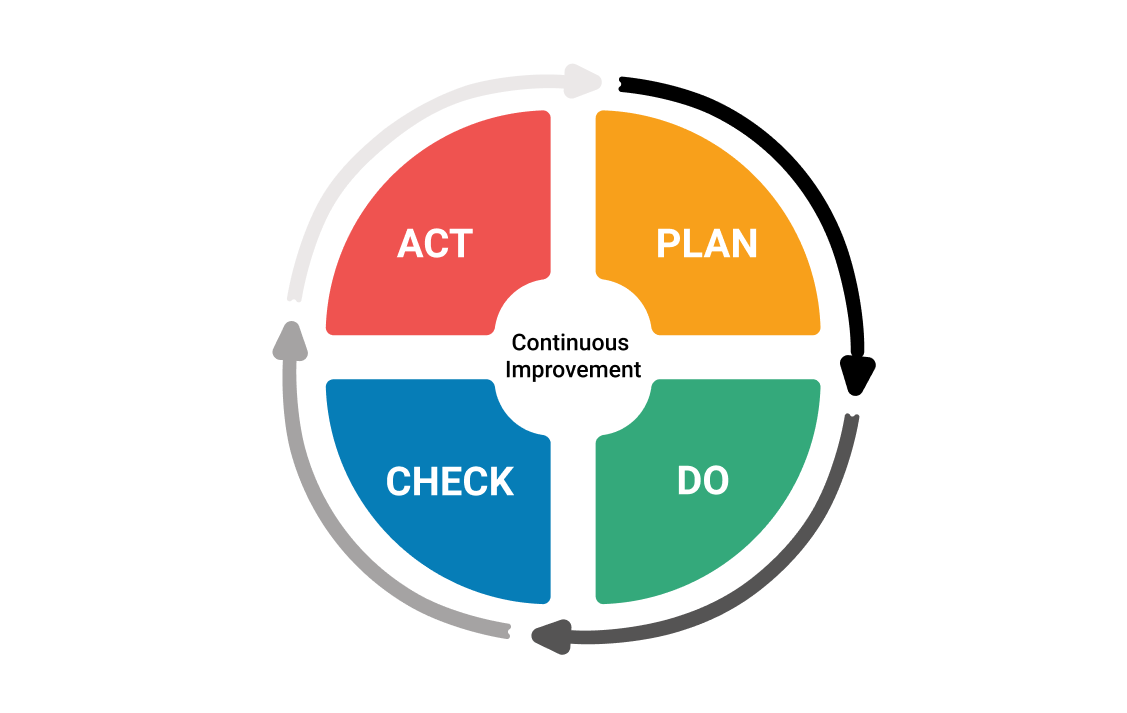
This eliminates the need for rework and wasted resources because improvements were identified and applied early in the Agile project management process. It is the regular deliveries and customer feedback that ensure the successful project delivery and meeting customer expectations.
What Are the Core Values and Principles of Agile?
Becoming agile is all about shifting your mindset and following specific values and principles in your work.
What Are the Four Key Values of Agile?
- Individuals and interactions over processes and tools.
- Working software over comprehensive documentation.
- Customer collaboration over contract negotiation.
- Responding to change over following a plan.
It's important to mention that these values were defined in the following format: "While we value the things on the right, we value the things on the left more". This means that processes and tools, documentation, contracts, and planning are still fundamental. We just have to use them wisely.
What Are the 12 Principles of Agile?
- The highest priority is to satisfy the customer through early and continuous delivery of valuable software.
- Changing requirements must be welcomed, even late in the development process. Agile processes harness change for the customer's competitive advantage.
- Working software must be delivered frequently, from a couple of weeks to a couple of months, with a preference for a shorter timescale.
- Business people and software developers must work together daily throughout the project.
- Build projects around motivated individuals. Give them the environment and support they need, and trust them to do the job.
- The most efficient and effective method of conveying information to and within a development team is face-to-face conversation.
- Working software is the primary measure of progress.
- Agile processes promote sustainable development. The sponsors, developers, and users should be able to maintain a constant pace indefinitely.
- Continuous attention to technical excellence and good design enhances agility.
- Simplicity – the art of maximizing the amount of work not done — is essential.
- The best architectures, requirements, and designs emerge from self-organizing teams.
- At regular intervals, the team reflects on how to become more effective, then tunes and adjusts its behavior accordingly.
Learn more about the 12 principles of Agile project management.
What Are the Benefits of Agile Working?
Adopting the Agile approach to project management offers numerous benefits. Some of the most significant advantages are supported by the latest statistics on Agile usage:
- Fostering a culture of accountability and a sense of shared ownership.
- Encouraging the exchange of diverse ideas through cross-functional collaboration and user engagement.
- Creating an environment and embracing the benefits of continuous improvement.
- Greater flexibility to adapt and manage the changing client requirements and product defects.
- Having clearly defined goals and a better understanding of the work process.
Why Are Businesses Turning to Agile Project Management?
Organizations increasingly adopt Agile because it improves their ability to respond to change, reduce project risks, and deliver value faster.
Industry survey shows that teams adopting the Agile way of working are experiencing similar benefits. To name a few, almost 2/3 of the participants report increased collaboration, and 57% note better alignment with business needs.
Businessmap is the most flexible software
to gain full work visibility across teams & portfolios
Traditional vs. Agile Project Management
Even though both approaches originated in different industries, today, they expand their application to various fields. Let’s briefly touch the surface of each one of them and uncover what is specific to Agile and traditional project management.
What Are the Most Popular Agile Project Management Methods?
As Agile became a prominent topic at the beginning of the 21st century, many frameworks rapidly gained popularity (Scrum, Kanban, SAFe, etc.). However, many companies seeking true business agility realized that highly prescriptive frameworks and agility are quite the opposite. This is why many organizations today are looking into different Agile methodologies that support building a stable Agile workflow and tailoring the processes to their own needs instead of adopting highly prescriptive frameworks.
Today, the most popular Agile project management frameworks and methods include Kanban, Scrum, and Scrumban.
Kanban
Kanban focuses on evolutionary change and continuous process improvements applied through six fundamental Kanban principles and practices.
At its core is workflow visualization, which allows managers and teams to organize and manage work much better, keep track of various projects, collaborate more effectively, and acquire a better overview of the process.
One of the most critical Kanban practices is limiting work-in-progress, which helps teams to increase their focus and prioritize finishing work to improve overall efficiency.
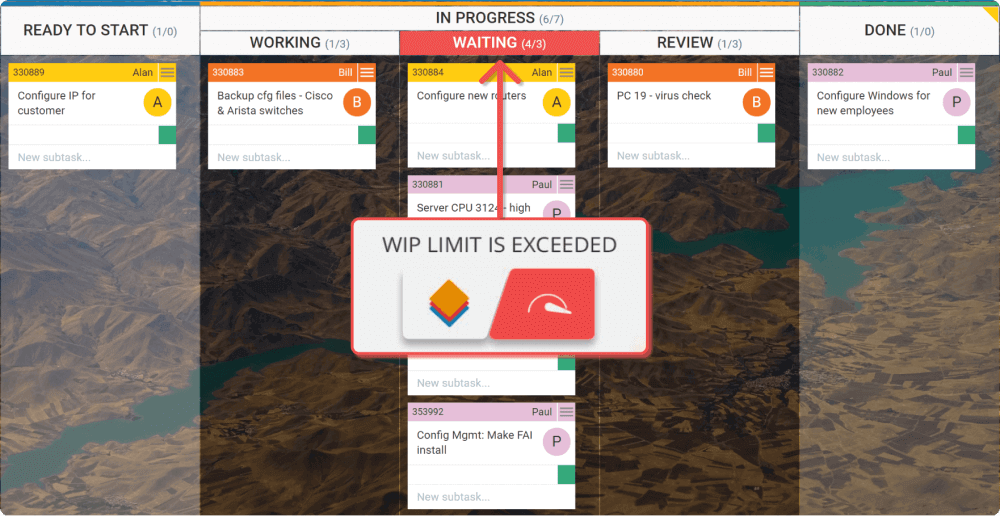 Apply WIP (Work-In-Progress) limits on a Kanban board
Dive deeper into Kanban and how to improve work efficiency with our dedicated article - What Is Kanban? Explained for Beginners.
Scrum
Scrum is an iterative approach that uses time-boxed intervals and splits projects into fixed periods called sprints. The primary purpose is to support teams to productively and creatively deliver products of the highest possible value.
How work is managed in Scrum is that from the product backlog, work items are selected and moved to the Sprint backlog until the capacity for the Sprint is reached. A self-organized or self-managed team does the work itself during the Sprint, which may be considered as projects with a fixed length of no more than one month.
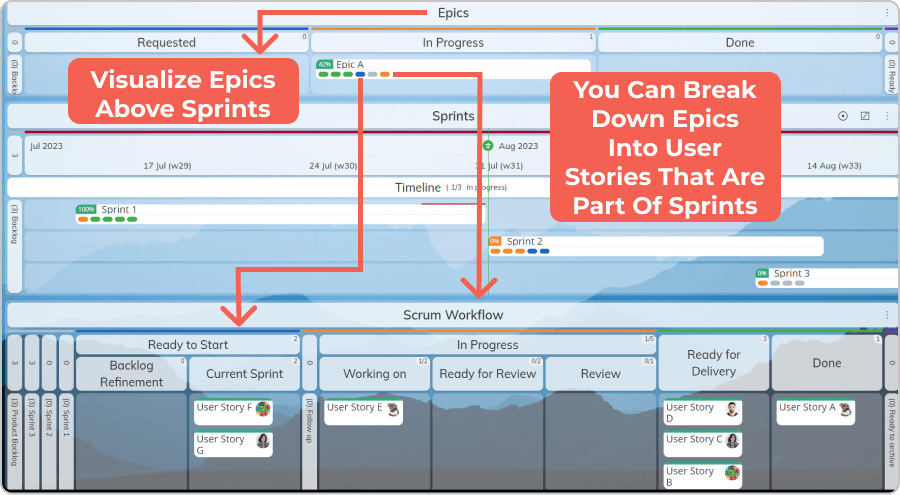 Visualization of a scrum workflow on a kanban board in Businessmap
Read our dedicated Scrum article to learn more about this Agile framework – its benefits, principles, roles, and artifacts.
Scrumban
Scrumban is an Agile approach for managing projects which resulted from the combination of the Scrum framework and the Kanban method. Scrumban takes Scrum to the next level by applying Kanban principles and practices. This allows teams to increase output and decrease waste while providing visibility and higher productivity. It also lets teams apply Agile planning to their full potential.
Get to know in detail how Scrumban works, its advantages and limits in our extensive guide.
How (And Why) Agile Project Management Works in Practice?
Even though Agile project management stems from the software development industry, it is successfully applied to many other areas, such as product development, architecture, marketing, financial services, etc.
Let’s follow the story of a telecom provider embracing Agile practices to modernize how its Integration department worked and align it with a more agile-focused business unit.
The team introduced Kanban-based workflows, combined with Agile ceremonies such as reviews and retrospectives, to improve how work was managed and delivered. By visualizing their processes on digital boards and analyzing workflow data, they gained better visibility into dependencies, bottlenecks, and overall performance.
As a result, the team improved coordination, reduced manual reporting time, and accelerated delivery. In one month alone, they identified multiple root causes of inefficiencies and resolved a significant portion of critical process issues, leading to faster and more predictable project flow.
Read the full story of Algar Telecom's agile journey with Businessmap.
FAQs
What Is Agile Project Management in Simple Terms?
In simple terms, agile project management means breaking large projects into smaller tasks and completing them in short cycles called iterations. Teams review progress regularly, gather feedback from stakeholders, and adjust priorities to improve results and respond to changing requirements.
Why Do You Need Agile Project Management?
Agile project management can help prioritize what matters. By fostering ongoing feedback exchange and working in short cycles, you can:
- respond faster to changing customer and market needs
- improve project predictability
- reduce risks
- delivering value in a timely manner, and
- achieve your goals confidently.
The iterative approach of Agile allows businesses to embrace true organizational agility and, most importantly, enhance their operations.
What Are the 5 Phases of Agile Project Management?
The Agile project delivery process can be summarized in the following phases:
- Envision: Create a high-level product/service vision for the customers as well as determine who will be involved in the project.
- Speculate: This is an extension of the "Envision" phase, where Agile teams gather the initial broad requirements for a product/service and develop an iteration plan based on the vision.
- Explore: Work on the project deliverables with a focus on flow, aiming to get feedback from the customer as fast as possible.
- Adapt: Review delivered results and adapt as necessary to current conditions.
- Close: Conclude the project, and pass along key findings.
What Are the Differences between an Agile and Waterfall Approach?
In short, Agile promotes working in small batches, adapting to changes as the project evolves, and continuously gathering customer feedback. Waterfall, by contrast, follows a fixed plan from beginning to end, focusing on finishing each phase at a time.
Four distinct elements underscore the difference between Agile and waterfall approaches to project management. These include:
- Prioritizing customer collaboration above predefined contracts agreed upon at the start.
- Emphasizing individuals and interaction over process and tools.
- Encouraging adaptation to changing requirements over following a detailed plan.
- Promoting the use of prototyping and working solutions rather than exhaustive documentation.
What Are Some Common Challenges Faced by Teams Implementing Agile Project Management, and How Can They Be Addressed?
Some common challenges faced by teams implementing Agile project management include resistance to change, lack of communication and collaboration, difficulty in adapting to new roles and responsibilities, and unclear goals and priorities.
To address these challenges, teams can:
- Encourage open communication and collaboration among team members.
- Provide proper training and support to help team members adapt to new roles and responsibilities.
- Establish clear goals and priorities for each iteration.
- Foster a culture of continuous improvement and adaptability.
- Address any resistance to change through education and active involvement of team members in the implementation process.
By addressing these challenges, teams can successfully implement Agile project management and achieve successful project outcomes.
How Does Agile Project Management Handle Project Risks and Changes during the Project Lifecycle?
Agile Project Management handles project risks and changes during the project lifecycle through continuous planning and adaptation. In Agile, risks are identified early and addressed through iterative and incremental development. The team prioritizes risks based on their impact, likelihood, and urgency and develops mitigation strategies accordingly.
Similarly, changes in the project scope or requirements are embraced as opportunities for improvement, and the team adapts its plans and processes accordingly. Regular reviews and retrospectives help the team to identify potential risks and changes and to adjust their approach as needed.
What Are the Key Responsibilities of an Agile Project Manager?
An agile project manager facilitates team collaboration, removes obstacles that slow progress, and ensures transparency across the workflow. They help teams stay aligned with project goals, empower them to self-organize their work, support Agile transformation efforts, and ensure work delivers measurable business value.
Businessmap is the most flexible software
to achieve full work visibility across teams and portfolios