For years, PM software has focused on tasks, timelines, and team-level coordination. But as we move through 2026, that old model is hitting a wall. Between cross-functional chaos and constant market shifts, simply "finishing tasks" isn't enough anymore.
That's why the latest trends in project management software point in one direction: from task coordination → to AI-assisted portfolio decision-making.
We've seen this massive shift, and the data shows we're all feeling it.
- According to Capterra, 55% of buyers say AI capabilities are now the top trigger for purchasing PM software
- Two out of three organizations are increasing PM software spend (Capterra)
- Yet 44% remain dissatisfied with their project management maturity (Wellingtone Report)
Let's unpack what's really changing and what it means for PMOs, transformation leaders, and enterprise teams.
Why the "Old Way" of PM Software Is Fading
The shift didn't start with AI. AI just accelerated it.
Organizations are becoming "project-driven enterprises", where value is delivered through initiatives, not static operations. At the same time, McKinsey highlights a new operating model: more tech-enabled, more adaptive, and more human-centered.
But here's the tension:
- More projects
- More dependencies
- More uncertainty
And yet, most teams still manage work in isolation.
We've seen this firsthand - teams optimizing sprint velocity while the portfolio quietly drifts off strategy. Everyone is busy, but there's no alignment. That's why portfolio thinking is no longer optional.
The 4 Defining Project Management Software Trends for 2026
1. AI-Native Platforms Replace Add-On Automation
AI is becoming the center of modern project management platforms.
Instead of static dashboards, we now see:
- AI-generated prioritization recommendations
- Real-time risk detection
- Predictive delivery insights
What makes AI so helpful is not that it makes decisions for you, but that it exposes trade-offs faster than humans can process them.
In platforms like Businessmap, AI connects portfolio data, workflow analytics, and execution signals to surface insights that were previously invisible.
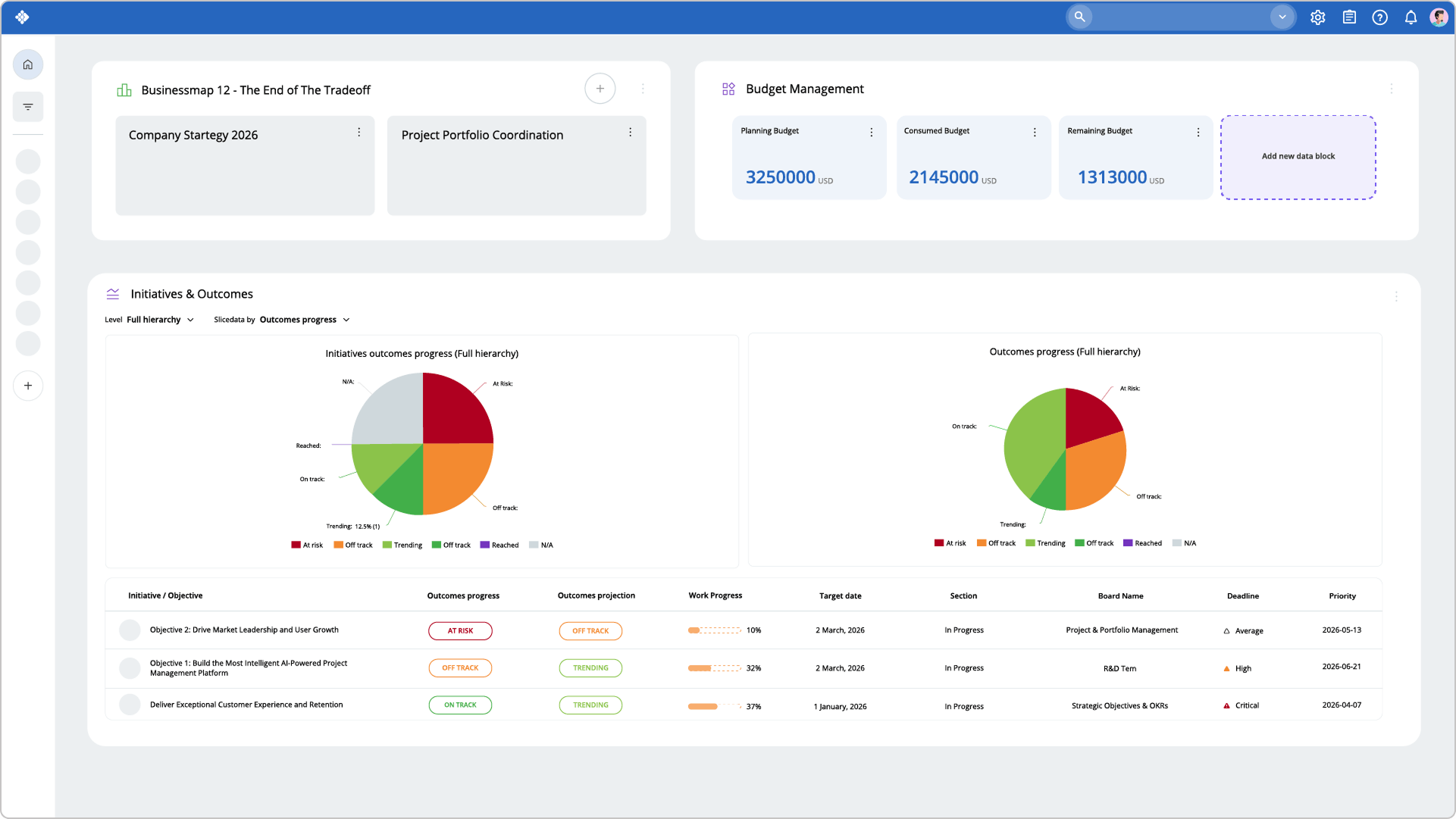 Visualizing goals report using executive dashboards in Businessmap
2. Portfolio Thinking Is the New Default
The most important shift is conceptual. Organizations are moving to managing portfolios of outcomes rather than projects.
This means:
- Prioritizing initiatives based on business value
- Visualizing dependencies across teams
- Continuously adjusting direction
And yet, only 22% of organizations report advanced project management maturity. (Wellington Report)
3. PMOs Shift from Governance to Strategy Execution Engines
PMOs are still evolving, and many are struggling to prove their value. They are becoming decision hubs.
- 86% of organizations now have a PMO
- Nearly 50% are less than four years old
The modern PMO must:
- Align strategy with execution in real time
- Enable fast, informed prioritization
- Eliminate reporting bottlenecks
Yet today, 72% of professionals still spend hours manually compiling reports, and half of the organizations lack real-time KPIs. (Wellingtone Report)
Businessmap addresses this directly by connecting strategy layers (portfolio boards) with execution workflows, eliminating the need for manual aggregation.
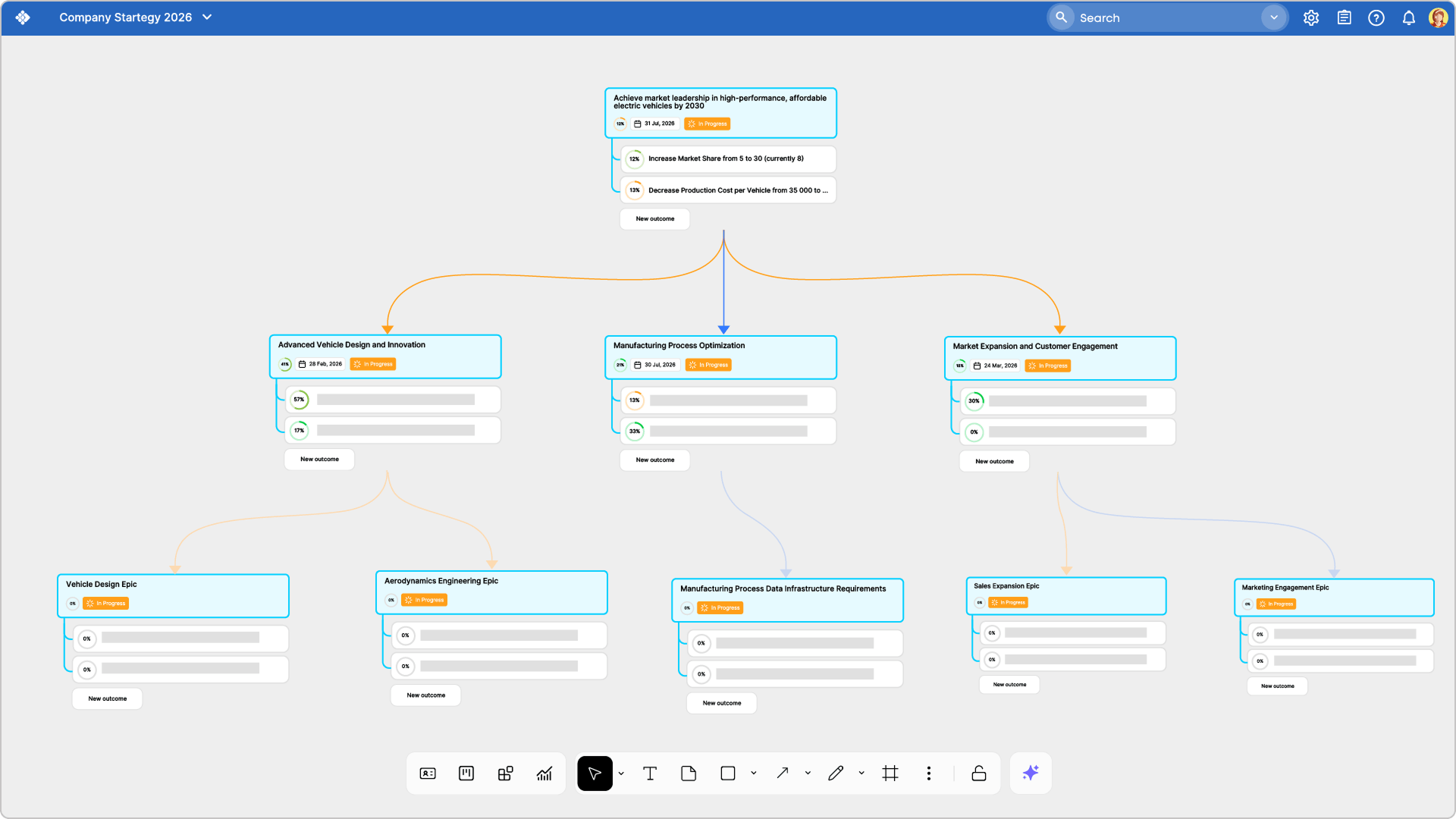 Visualizing the strategic goals, portfolio, and project-level initiatives using the AI Canvas board in Businessmap
→ Check our dedicated list of Enterprise PMO Software for Strategic Execution
4. Continuous Adaptation Is the Only Plan
Transformation used to be a project, but now it's the state of things. McKinsey's research reinforces this: organizations must operate in a state of continuous adaptation.
That requires:
- Ongoing visibility into change initiatives
- Fast feedback loops
- Alignment across leadership layers
AI plays a critical role here by:
- Detecting early signals of disruption
- Highlighting misalignment
- Suggesting corrective actions
How Generative AI Is Transforming Project Portfolio Management
In traditional PPM environments, decisions were slow, periodic, and often based on incomplete data. Leaders relied on quarterly planning cycles, static business cases, and lagging indicators. By the time a decision was made, the context had already shifted.
AI for Prioritization
Traditional prioritization models operate on a flawed assumption: that conditions remain stable. In reality, priorities shift weekly, sometimes daily.
AI enhances prioritization by continuously evaluating:
- Cost of delay in real time
- Strategic alignment against evolving goals
- Resource constraints across teams and departments
Instead of locking decisions into annual or quarterly cycles, organizations can now re-prioritize dynamically, based on actual execution signals.
That's why platforms that can connect strategic initiatives to execution data and automatically highlight when priorities should shift are becoming increasingly popular.
AI for Predictive Delivery
Most organizations still operate in a reactive mode, but with AI, this changes. According to PMI, 82% of organizations actively work to predict and mitigate roadblocks.
It enables:
- Early detection of bottlenecks based on flow data
- Forecasting delivery risks across multiple teams
- Proactive recommendations for corrective actions
This means you don't manage risks after they appear; you manage the conditions that create them.
In a portfolio context, this means identifying systemic overloaded teams, hidden dependencies, or too many conflicting priorities.
AI for Workflow Optimization
AI can now analyze flow efficiency across teams. It can:
- Detect where work is getting stuck
- Identify recurring bottlenecks
- Recommend structural improvements to workflows
This moves organizations from local optimization → system-wide optimization.
In practice, this shift becomes critical in complex R&D environments. One example comes from Italian-based manufacturer BFT, where multiple cross-functional teams were managing around 30 concurrent projects. Each team was optimizing its own work, but there was no shared visibility into dependencies or flow across the system. The result was systemic delay at the portfolio level.
Once they introduced a connected workflow model, linking portfolio planning with execution, the bottlenecks became visible. Dependencies that previously caused silent delays could now be managed proactively. Instead of reacting to missed deadlines, teams started adjusting flow in real time. (Read the Full Case Study)
This is exactly where AI amplifies the impact.
When workflow data is connected end-to-end, AI can surface:
- Hidden dependency risks
- Flow interruptions across teams
- Structural inefficiencies that repeat over time
In platforms like Businessmap, this becomes tangible through end-to-end workflow visualization, where AI-driven insights highlight not just where work is delayed, but why the system creates those delays in the first place.
AI and the Human Factor
There's a common fear that AI reduces the need for human input. As AI surfaces more data, more scenarios, and more trade-offs, the role of human judgment becomes more critical.
In fact, 60% of project managers report that AI adoption has increased their reliance on emotional intelligence. (Capterra)
AI can improve the quality of our decisions, but humans still own the consequences.
- Data can highlight conflicts, but leaders must resolve them
- AI can suggest priorities, but stakeholders must align on them
- Systems can optimize flow, but people must navigate change
→ Discover more ways how to use AI in project and portfolio management with Businessmap
How to Choose Your 2026 Project Management Software Toolkit
When looking at software this year, ask one big question: "Do we need better execution, or better decisions?"
Then evaluate:
- Complexity of your organization
- Number of dependencies
- Need for strategic alignment
Ask:
- Can this tool help us prioritize dynamically?
- Does it connect strategy to execution?
- Does it give us real-time visibility into outcomes?
The Future Belongs to Portfolio-Centric, AI-Driven Organizations
Here are the facts:
- AI is reshaping how decisions are made
- PMOs are becoming strategic enablers
- Portfolio thinking is replacing project-level optimization
- And yet, most organizations are still catching up.
In 2026, competitive advantages don't come from delivering faster but from deciding better.
For project teams that want AI embedded into their decision workflows as a conversational layer — surfacing blockers, flagging at-risk initiatives, and answering portfolio questions in natural language — conversational AI development services build these interfaces directly into existing enterprise systems rather than adding yet another dashboard.
This is exactly where AI-native platforms like Businessmap come in, helping organizations move beyond task coordination and into real-time, portfolio-level decision-making.
Because in the end, success isn't about how many projects you complete.
It's about whether you're working on the right ones.
See how Businessmap supports organizations operating at scale, delivering portfolio visibility and execution in one place.

Michaela Toneva
Kanban & Agile Practitioner | SEO & Content Creator
With a never-ending thirst for knowledge and a passion for continuous improvement, Michaela is an Agile practitioner with a good understanding of Kanban, Lean, and Agile methodologies. Her professional background includes SEO and content writing with a dose of sales and a pinch of social media.