Most organizations don't struggle with project execution - they struggle with seeing the whole picture.
At some point, growth exposes the cracks. Reporting becomes slow. Priorities conflict. Leaders ask simple questions and get inconsistent answers. Teams optimize locally while strategy drifts globally.
That's when PPM implementation becomes business-critical.
But here's the catch: implementing project portfolio management is not a tooling exercise. It's an organizational reset - one that touches data, governance, and behavior.
This guide walks you through how to do it right, based on real-world experience.
Why Do Organizations Need PPM Implementation?
Most organizations don't wake up and decide they need PPM. They reach a breaking point.
It usually looks like this:
- Projects exist across multiple tools (Excel, PowerPoint, MS Project) with no single source of truth
- Reporting takes days or weeks to compile manually
- Leaders ask simple questions like "Who owns this project?" and no one can answer quickly
- Teams prioritize locally, while strategy drifts globally
- Resource allocation is based on assumptions, not data
At scale, this creates a dangerous illusion: activity looks high, but outcomes are unclear.
PPM implementation solves this by creating:
- Centralized portfolio visibility
- Standardized governance and reporting
- Data-driven decisions
- Alignment between strategy and execution
But getting there requires more than deploying a tool.
How to Define Success Criteria Before Implementing PPM
Success criteria for a PPM rollout could mean faster reporting cycles, clearer prioritization, or improved resource allocation, but unless those goals are explicitly defined, the implementation will drift.
Executive sponsorship plays a key role. Without it, PPM becomes an administrative layer rather than a decision-making engine.
At the same time, governance needs to be clarified: who approves projects, how priorities are set, and how progress is reviewed.
Data readiness is the silent constraint. If your current data is inconsistent, incomplete, or scattered across systems, the new PPM environment will simply reflect those same issues with more visibility.
Assess Your PPM Maturity Before Choosing an Approach
Not every organization should implement PPM in the same way.
Some are still heavily reliant on Excel and informal processes. Others have established PMOs but have difficulty with fragmented tools. A smaller group operates at scale but lacks strategic alignment across portfolios.
The right approach should depend on where you are today. Implementing PPM too early creates friction, but implementing it too late creates inefficiency.
PPM Maturity vs. Implementation Approach
How to Align PPM Implementation with PMO and EPMO Governance?
PPM is not a replacement for governance; it's an enabler.
A successful implementation should reinforce:
- Portfolio intake processes
- Prioritization frameworks
- Stage gates and approvals
- Executive reporting cadences
- Risk and dependency tracking
In practice, this often requires adjusting existing processes.
For example:
- redefining roles (e.g., moving from "project managers" to broader "delivery managers")
- standardizing lifecycle stages across all work types
- ensuring every initiative has clear ownership
This alignment is what turns PPM from a reporting layer into a decision-making system.
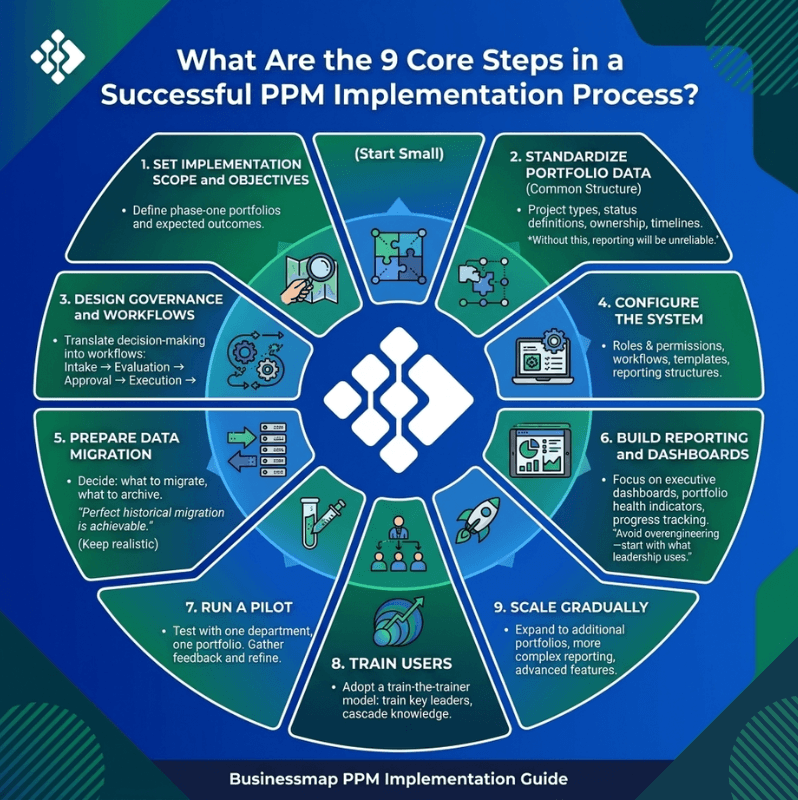
What Are the 9 Key Steps in a Successful PPM Implementation Process?
Here's what a practical implementation actually looks like.
1. Set Implementation Scope and Objectives
Start small. Define:
- which portfolios are included
- what outcomes you expect in phase one
2. Standardize Portfolio Data
Create a common structure:
- project types
- status definitions
- ownership fields
- timelines and milestones
Without this, reporting will be unreliable.
3. Design Governance and Workflows
Translate decision-making into workflows: intake → evaluation → approval → execution → closure.
4. Configure the System
Set up:
- roles and permissions
- workflows
- templates
- reporting structures
5. Prepare Data Migration
Decide:
- what historical data to migrate
- what to archive
6. Build Reporting and Dashboards
Focus on:
- executive dashboards
- portfolio health indicators
- progress tracking
Avoid overengineering; start with what leadership actually uses.
7. Run a Pilot
Test with:
- one department
- one portfolio
Gather feedback and refine.
8. Train Users
Adopt a train-the-trainer model:
- train key leaders
- cascade knowledge to teams
9. Scale Gradually
Expand to:
- additional portfolios
- more complex reporting
- advanced features
Phased vs. Big-Bang PPM Rollout
One of the most debated decisions is whether to implement PPM gradually or all at once.
A phased rollout reduces risk. It allows teams to adapt incrementally, builds confidence, and enables continuous improvement. This is the approach most large organizations take, especially those operating in regulated environments.
A big-bang implementation, on the other hand, can accelerate standardization but comes with higher disruption. It requires strong governance, clean data, and high organizational readiness.
In reality, even organizations that plan a big-bang approach often revert to phased execution once they encounter real-world complexity.
How to Handle Data Migration and Reporting When Implementing PPM?
Reporting is only as good as your data model. Users expect the new system to replicate familiar reports, often built in Excel over the years. At the same time, modern PPM tools come with pre-built dashboards that don't always match specific organizational needs.
Data Migration Challenges
- incomplete historical data
- incompatible formats across tools
- difficulty importing legacy schedules
Most organizations eventually:
- define a cutoff point for historical data
- focus on forward-looking accuracy
Reporting Design Challenges
- users want familiar reports (often Excel replicas)
- out-of-the-box dashboards rarely match exact needs
- advanced reporting tools (e.g., Power BI) require expertise
If you don't invest in reporting design early, adoption will suffer.
What KPIs to Track During PPM Rollout?
Most organizations track project performance, but few track implementation success.
The real question is not whether projects are delivered, but whether the system is improving decision-making.
- Adoption metrics provide early signals. If teams are not updating data regularly or continue using parallel tools, the implementation is at risk.
- Data quality metrics reveal whether information can be trusted.
- Governance metrics show whether processes are being followed.
- Over time, value metrics emerge. Reporting cycles shorten. Visibility improves. Resource allocation becomes more predictable.
These metrics tell you whether PPM is actually improving how the organization operates.
What Are the Most Common Challenges During a PPM Adoption?
Every implementation surfaces similar patterns.
Not Enough Data
Stakeholders often ask for more data, but what they actually need is better information. This distinction matters because excessive data collection slows down adoption.
Resistance to Change
Teams are comfortable with tools like Excel because they are flexible and familiar. Moving to a centralized system feels restrictive, especially when it introduces additional work.
Training Overhead
Training also becomes a bottleneck. What was previously managed by a small group now requires broad participation across the organization. Not everyone immediately sees the benefit.
Running New and Old Systems in Parallel
Then there's the "parallel systems" dilemma. Teams don't want to abandon existing tools until the new system proves itself, but running both creates duplication.
Historical Data Expectations
Expectations around historical data can derail progress. Many stakeholders expect full backward visibility, but most PPM systems are optimized for real-time data.
These challenges are not signs of failure. They are part of the process.
How a Global Engineering Organization Transformed PPM With Businessmap
One of the most common objections to PPM implementation is simple: "Will this actually work in a complex, real-world environment?"
A global manufacturer of electronic components faced exactly that challenge.
After a strategic acquisition, the organization needed to integrate multiple teams, processes, and locations, each with different ways of working. Initially, they relied on Excel to manage projects, but the system quickly broke down. Reporting became time-consuming, visibility was limited, and coordination across teams suffered.
As one manager put it: "I am spending most of my time with status updates… It's a huge waste of time."
What Changed
The company introduced Businessmap as part of a broader shift toward visual, connected portfolio management.
They started small focusing on one engineering team and implemented:
- visual workflows across projects, services, and daily work
- clear process policies and stage-gate governance
- real-time tracking of work across teams and locations
- a unified system combining execution and quality management
Over time, they scaled this approach across the organization, aligning strategy with execution using a multi-level portfolio structure.
The Results
The impact was measurable:
- Product development cycle time reduced from 36 to 26 months (~30% improvement)
- Divisional turnover increased by 250%
- Full end-to-end visibility across projects and teams
- Successful ISO 9001 audit compliance with real process adoption
Perhaps more importantly, the organization didn't just implement a system; they built a mindset of continuous improvement, embedding feedback loops and learning into every stage of work.
What Change Management Practices Drive PPM Adoption?
PPM implementation is a change initiative, not an IT project. The most effective organizations treat it as such.
What works:
- Stakeholder alignment early
- Clear communication of benefits
- Role-based training
- Internal champions
- Quick wins during pilot phases
One of the most important insights is that the value of PPM is often organizational rather than individual. Teams may not immediately see the benefit, even though leadership gains better visibility. Closing that gap is the key to adoption.
How to Implement Businessmap for PPM Step by Step
Once the fundamentals are in place, the tool should reinforce your operating model.
Here's how this translates into Businessmap.
1. Map Strategy to Execution
In Businessmap, PPM implementation starts by connecting strategy to execution. Strategic goals are visualized and broken down into initiatives, which are then linked to execution workflows. This ensures that every piece of work contributes to a measurable outcome.
Start by visualizing:
- strategic goals
- initiatives
- measurable outcomes
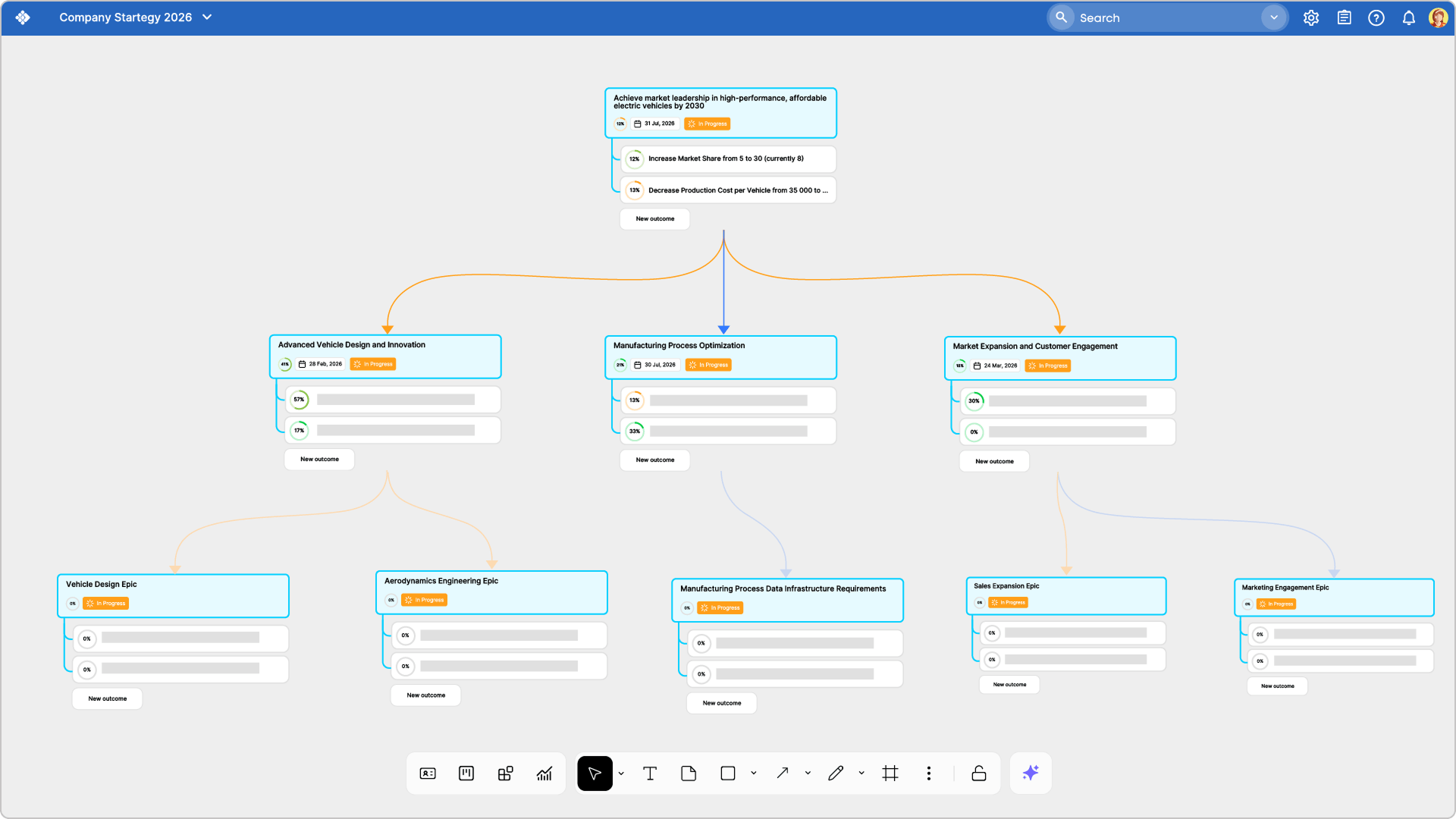 Visualizing the links between strategic goals, portfolio, and project-level initiatives using the AI Canvas board in Businessmap
2. Use Planning Boards for Portfolio Design and Team Workspaces for Execution
Planning happens on flexible canvas boards, where teams can map initiatives, dependencies, risks, and scenarios. Execution, on the other hand, is managed through workflow boards customized for various teams, whether they follow Kanban, Scrum, or mixed approaches.
3. Connect Work Across Teams
What makes this powerful is the connection between layers. A single click allows you to trace work from a strategic objective down to individual tasks across teams. This creates true portfolio visibility.
Link:
- strategic initiatives
- portfolio workflows
- team-level tasks
This creates a single connected system, where every piece of work contributes to a larger objective.
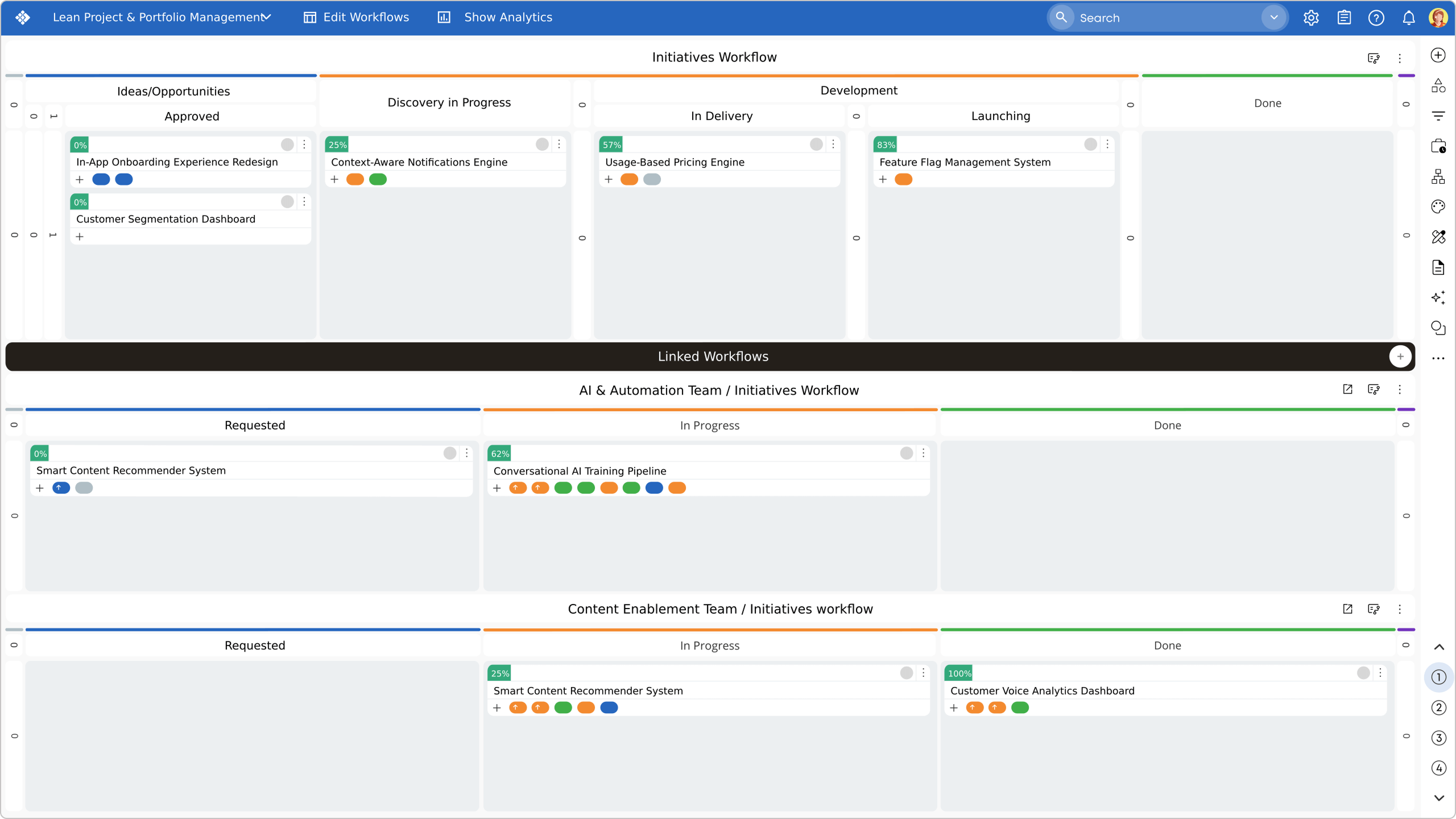 Visualizing project portfolio and work coordination boards in Businessmap
4. Configure Workflows and Governance
To ensure consistency across the portfolio, define:
- lifecycle stages
- approval processes
- ownership rules
5. Build Executive Dashboards
Reporting is built into the system. Executive dashboards provide instant insights into progress, risks, and alignment. Instead of preparing static reports, teams can interact with live data and drill down into details.
Use built-in dashboards to:
- track progress toward goals
- identify risks
- monitor delivery performance
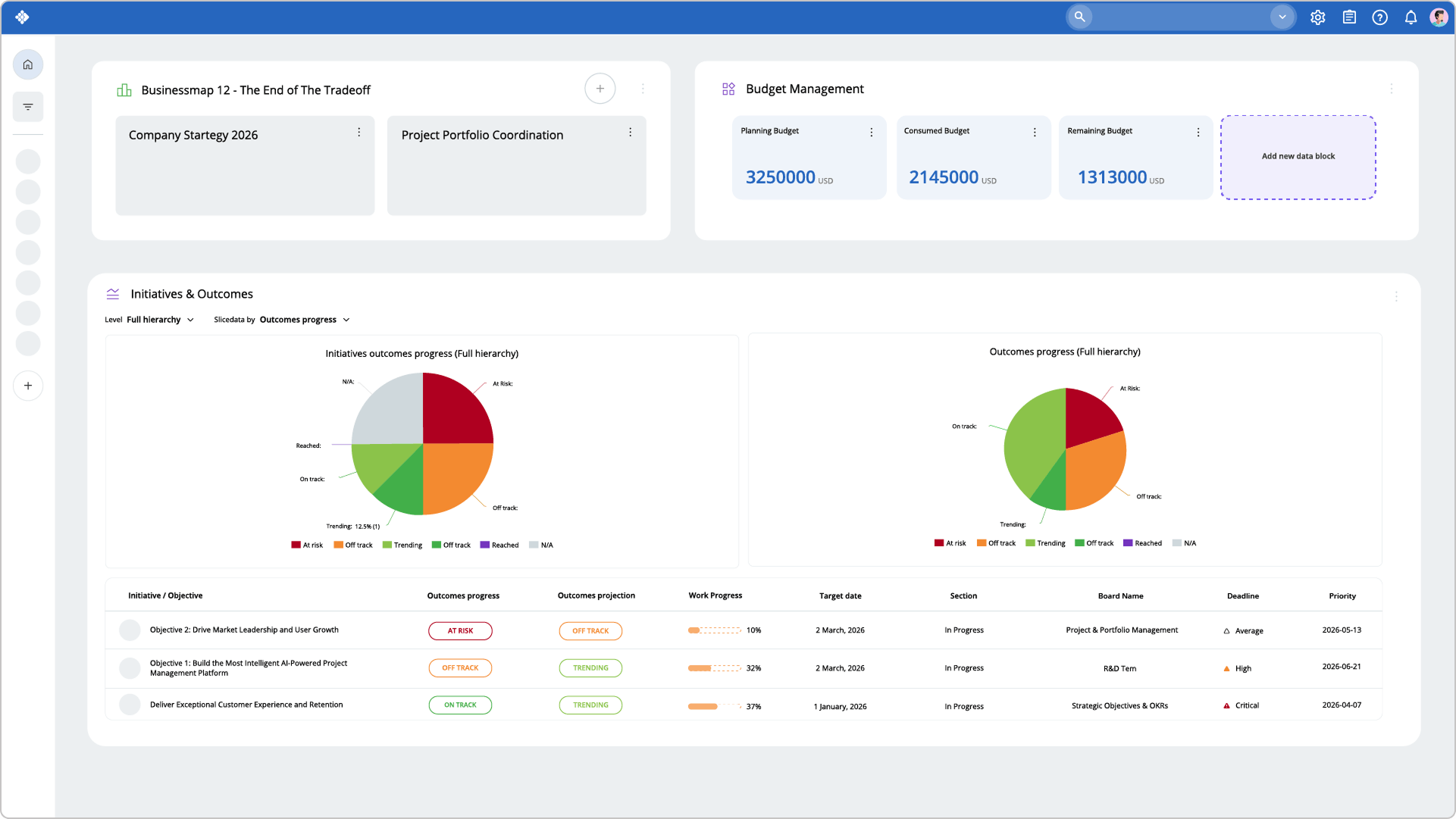 Visualizing goals report using executive dashboards in Businessmap
6. Scale Across the Organization
Start with one portfolio, then expand to:
- multiple departments
- cross-functional initiatives
- enterprise-wide strategy execution
If you want to see how this works in practice, Businessmap provides a full walkthrough of Agile portfolio management, from strategic planning to team execution, showing how all layers connect in a single system.
See how Businessmap supports organizations operating at scale delivering portfolio visibility, resource planning, and execution in one place.

Iva Krasteva
Content Strategist | Agile Practitioner | Kanban Certified
Iva is a Kanban-certified Agile expert with hands-on experience in SEO, content creation, and Lean practices. She has published dozens of articles on Lean, Agile, and Kanban practical applications. Iva actively promotes collaborative, flexible work environments and regularly shares process optimization insights through writing.