On March 28, 2029, Jira Data Center will be retired. Your teams may still be able to view existing information, but they will no longer be able to create or update work normally. Atlassian will also stop providing regular support, maintenance, and security fixes.
Whether you move to Atlassian Cloud or replace Jira Data Center with another platform, there's time to prepare, but you can't postpone the decision indefinitely.
For organizations that depend on Jira beyond software development, the transition also presents an opportunity to choose a platform that connects projects, portfolios, strategic initiatives, and day-to-day execution.
This guide explains what happens when Jira Data Center reaches end of life, what to look for as a replacement, and which alternatives are most relevant to enterprise teams.
The retirement deadline creates both a migration requirement and an opportunity to rethink how your organization connects strategy, portfolio planning, projects, and execution.
What Happens Next?
If an organization does not migrate, its affected Data Center environment will become read-only.
What Are the Risks of Waiting?
The deadline may feel distant, but enterprise migrations rarely happen quickly.
A large Jira environment can include hundreds of projects, custom fields, workflow rules, Marketplace apps, integrations, and years of historical data. Starting today, you'll have the time to clean up that environment, compare alternatives, run a pilot, and migrate in controlled stages without stress.
Be proactive and begin the evaluation early enough to make a deliberate decision.
What Should You Look for in a Jira Data Center Replacement?
The right replacement depends on what Jira does in your organization today.
Before comparing tools, determine which capabilities must remain and which problems the new platform should solve.
What Type of Jira Alternative Does Your Organization Need?
Jira Data Center alternatives fall into several broad categories. The most suitable category depends on the work the platform must manage and the stakeholders who need visibility.
Issue tracking and DevOps platforms are strongest when engineering delivery is the primary concern. Project and portfolio management platforms are generally the strongest fit when the organization must connect technical and business work with programs, portfolios, and strategic priorities.
Best Jira Data Center Alternatives for Enterprise Teams
There is no universal replacement for Jira Data Center. The strongest option depends on your primary need.
Which Jira Alternative Is Best for Enterprise PMOs and Portfolio Management?
The best Jira alternative for an enterprise PMO depends on what the organization expects the platform to manage.
For organizations that need to connect team delivery to projects, strategic initiatives, and measurable outcomes, Businessmap is a strong alternative to Jira Data Center.
#1: Choose Businessmap for Strategy Execution and Cross-Team Visibility
Businessmap allows teams to coordinate work through separate but connected boards. Technical, operational, and business teams can use workflows appropriate to their work while portfolio leaders maintain visibility across the wider system.
This helps prevent a common enterprise problem: every team has a functioning board, but no one can see how the work fits together. At the same time, PMO and executive users can monitor dependencies, delivery risks, project health, and strategic progress across the organization.
Businessmap is particularly relevant when:
- Portfolio reporting depends heavily on spreadsheets.
- Teams work in separate systems or disconnected boards.
- Leaders need traceability from strategic objectives to execution.
- The organization wants to improve flow and delivery predictability.
- Both technical and nontechnical teams need to use the platform.
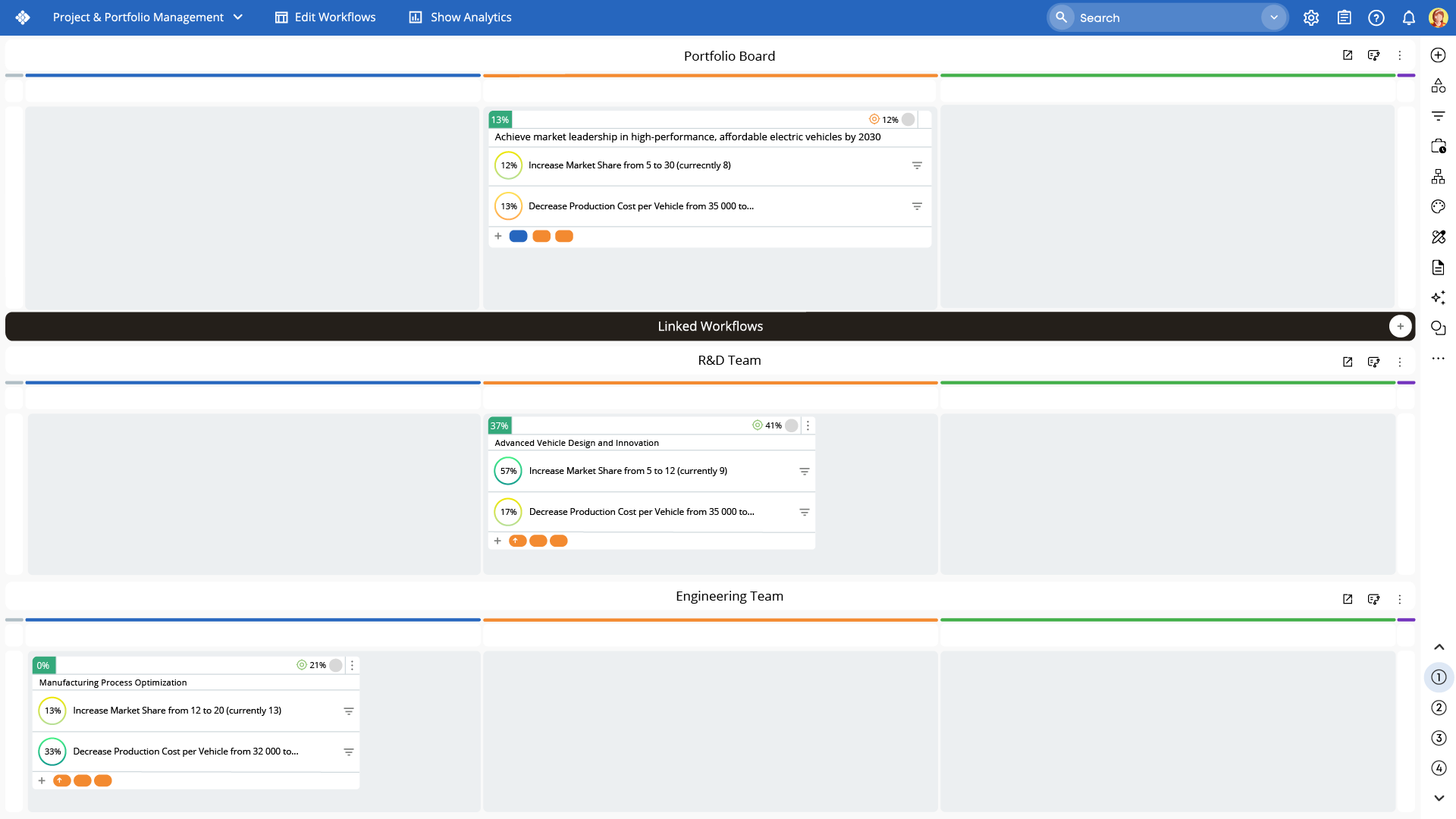 Connected Businessmap boards showing distributed work on delivery boards in one ecosystem
#2: Choose Planview for Formal Enterprise Portfolio Governance
Planview is better suited to large organizations with mature portfolio management processes and formal governance requirements.
It may be a good fit when the PMO needs extensive portfolio planning, investment prioritization, resource management, financial oversight, and scenario analysis across a large project landscape.
The tradeoff is that broader functionality can require a heavier implementation and more structured administration.
#3: Choose Easy8 for Hybrid Delivery and On-Premises Control
Easy8 is relevant to technology and engineering teams that need to combine Agile and Waterfall project management workflows.
The platform includes portfolio dashboards, resource and workload management, budgeting, time tracking, HelpDesk capabilities, and integrations with GitLab and GitHub. It also offers on-premises deployment, which may be important for organizations with strict data-sovereignty or infrastructure requirements.
Easy8 may be a strong fit when:
- Teams manage both structured and iterative projects.
- On-premises deployment is a firm requirement.
- Development activity must remain visible alongside project plans.
#4/5: Choose Azure DevOps or GitLab for Engineering-Led Portfolios
Azure DevOps and GitLab are most appropriate when the portfolio consists primarily of software development initiatives.
Both platforms provide strong connections between planned work and engineering delivery. They can help technology leaders monitor backlogs, releases, code, pipelines, and deployment activity.
However, organizations should examine whether they provide enough support for business portfolios, strategic planning, executive reporting, and nontechnical stakeholders without additional tools.
#6 Choose OpenProject for Open-Source and Self-Hosted Project Management
OpenProject is a suitable Jira Data Center replacement for organizations that want to retain control over their hosting, source code, and project data. It supports Agile, Waterfall, and hybrid project management and is available as a self-hosted Community or Enterprise edition, as well as an EU-hosted cloud service. It is especially relevant to public-sector, research, and regulated organizations that prioritize data sovereignty, open-source transparency, and reduced dependence on a proprietary vendor.
Find more EU-hosted Jira alternatives
#7: Choose Atlassian Cloud to Preserve the Existing Ecosystem
Atlassian Cloud is the most direct route for organizations that want to retain familiar Jira workflows and integrations.
This option can reduce the amount of process change required, but it may not resolve existing problems with configuration complexity, cost, or low adoption outside technical teams.
Before selecting Atlassian Cloud, PMOs should decide whether their goal is primarily to migrate Jira or to improve the organization's portfolio management.
When Businessmap Is the Right Jira Data Center Alternative
Businessmap is particularly relevant when Jira has grown from an engineering tool into a system that the wider organization depends on, but still does not provide the portfolio visibility leaders need.
Consider Businessmap when:
- A PMO spends too much time consolidating status reports.
- Teams use separate tools that hide cross-functional dependencies.
- Executives cannot connect strategic initiatives with delivery work.
- Nontechnical stakeholders struggle to navigate Jira.
- Portfolio reporting depends on spreadsheets and manual updates.
- The organization needs flexible workflows with centralized governance.
Create a clearer and more manageable system for connecting strategy, projects, and execution.
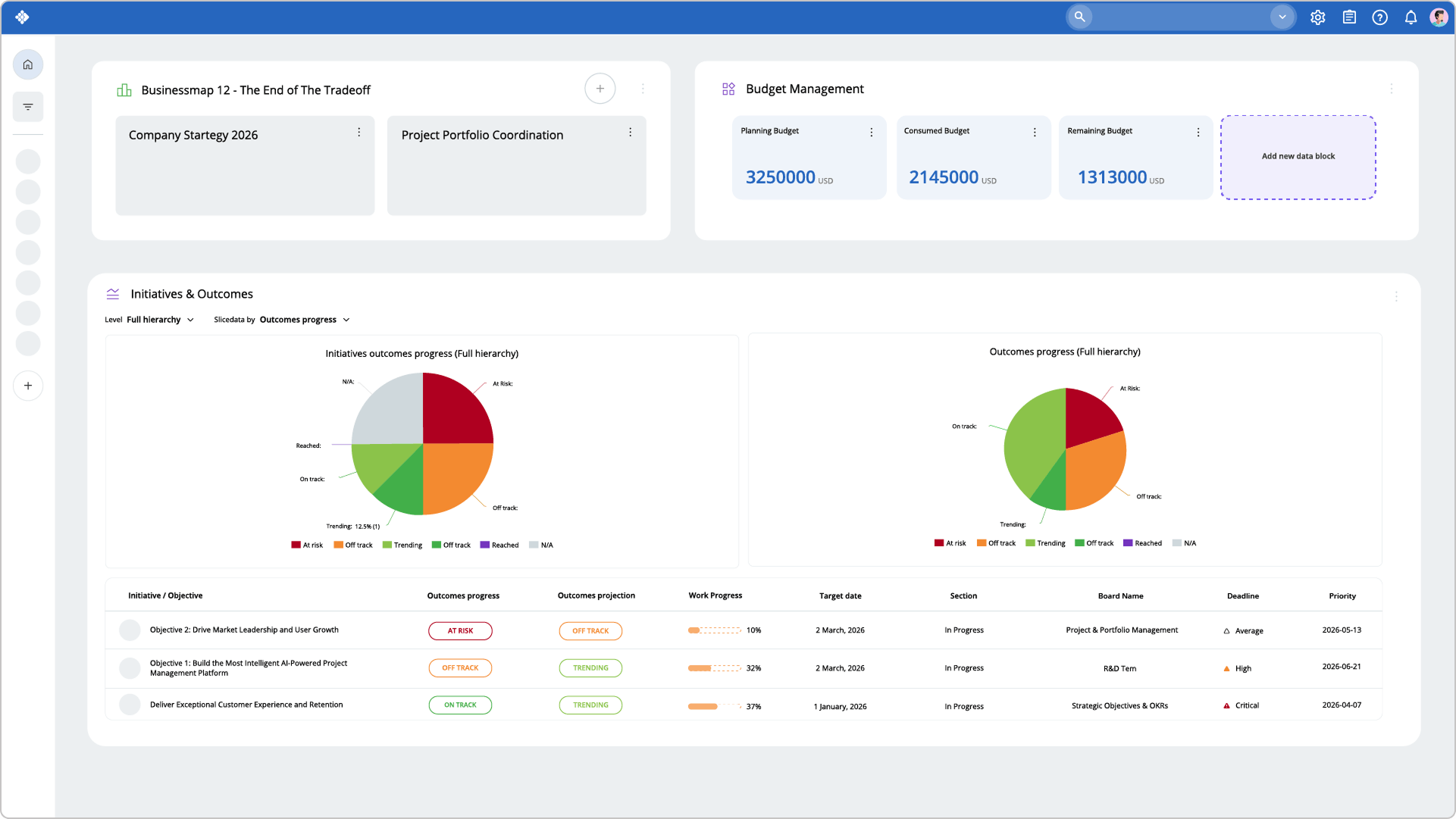 Businessmap executive portfolio dashboard with projects, dependencies, risks, and strategic objectives
Evaluate Businessmap as Your Jira Data Center Alternative
Request a demo to see how Businessmap can support your workflows, portfolios, dashboards, permissions, and migration requirements.
Request a Demo
Frequently Asked Questions
Can Nontechnical Stakeholders Use Businessmap?
Yes. Businessmap supports different views and levels of detail for different stakeholders. Delivery teams can manage daily work on boards, while PMO and executive users can rely on project, portfolio, dashboard, initiative, and outcome views.
Does Businessmap Support Portfolio-Level Planning and Reporting?
Yes. Businessmap connects work across teams, projects, programs, and strategic initiatives. Portfolio leaders can monitor progress, dependencies, risks, delivery data, and outcomes without manually combining information from separate project boards.
Is Businessmap Suitable for Regulated or Security-Conscious Organizations?
Businessmap provides configurable roles, board-level permissions, administrative privileges, security controls, and audit logs.
Organizations should validate these capabilities against their specific regulatory, security, data residency, and contractual requirements before selecting any platform.
What Integrations Are Available for Development and PMO Workflows?
Businessmap supports integrations through custom connectors, APIs, webhooks, and a remote MCP.
What Jira Replacement Is Easiest to Implement?
The easiest replacement depends on the existing environment. Organizations with simple issue-tracking needs may implement a lightweight platform quickly.
Enterprises with many integrations, custom workflows, and portfolio reporting requirements should prioritize controlled migration and long-term fit over the fastest initial setup.

Iva Krasteva
Content Strategist | Agile Practitioner | Kanban Certified
Iva is a Kanban-certified Agile expert with hands-on experience in SEO, content creation, and Lean practices. She has published dozens of articles on Lean, Agile, and Kanban practical applications. Iva actively promotes collaborative, flexible work environments and regularly shares process optimization insights through writing.