Bft, headquartered in Schio, Italy, makes gate automation systems, automatic doors, barriers, and other access security devices. It serves two markets, Residential & Industrial and Commercial & Urban, and has been part of the Somfy Group since 2004. With about 500 employees, 20 branches, and more than 530 distributors worldwide, Bft relies on its R&D group to keep its products ahead of the market.
The challenge: A project roadmap disconnected from the teams doing the work
Bft's R&D group runs around 30 hardware projects at a time, each lasting one to two years. Every project involves cross-functional teams of mechanical, electronic, firmware, software, and operations engineers. Because hardware development involves expensive tooling, long lead times, and rising costs for late changes, Bft managed projects through a Stage-Gate process planned in a Gantt chart tool.
By 2015, the limits were clear:
- Planning disconnected from execution: the roadmap lived in Gantt charts and Excel, with no link to the teams' actual work. It was hard to communicate priorities or what needed doing when.
- Hidden dependencies: as the portfolio grew, no one could see how projects and teams depended on each other, which risked delays between project phases.
- Stress and low ownership: milestones were set top-down without detail, so engineers didn't know where work came from or what was expected. They felt they didn't own their work.
What changed: First Steps on the Lean/Agile Journey
Physical boards were the first step
Bft began with Lean practices: visual management, cross-functional teams, decentralized planning, and continuous improvement. It set up a project room with physical boards for each project and one for the portfolio. The mechanical team planned in weekly cycles. The electronics team adopted a flow-based Kanban approach, with classes of service and stickers to mark blocked work. Technical and service department managers became facilitators, giving engineers a clear person to escalate problems to.
Visibility improved, but the boards had limits. They showed no hierarchy of work, planning still happened separately in Gantt charts, and each board covered only one project or team. Dependencies across the portfolio stayed hidden, and the practices couldn't scale to other business areas.
O-nami helped scale Kanban
Bft brought in Kanban consultant David Bramini, founder of O-nami. With his help, the teams matured their Kanban practices and moved to Businessmap. They followed Kanban's first principle, "start with what you do now": they recreated their physical boards and Stage-Gate process digitally first, then improved them step by step.
Discover how Kanban project management software helps teams visualize work, manage flow, and deliver projects more predictably. Explore Kanban Project Management Software↗
One portfolio board for all R&D projects
At the portfolio level, Bft built an R&D Projects board in a Businessmap Portfolio Workspace:
- Pipeline: management reviews and prioritizes upcoming projects.
- Project categories: projects are split into technology building blocks, such as operating systems and databases, and product projects.
- Stages and business areas: columns show each project's stage (Evaluation, Feasibility, Study, Realization), and lanes separate business areas such as residential and industrial, parking, and commercial and urban.
- Timeline: each project is broken into deliverables planned on a timeline.
The board became the central place to discuss how projects relate to each other.
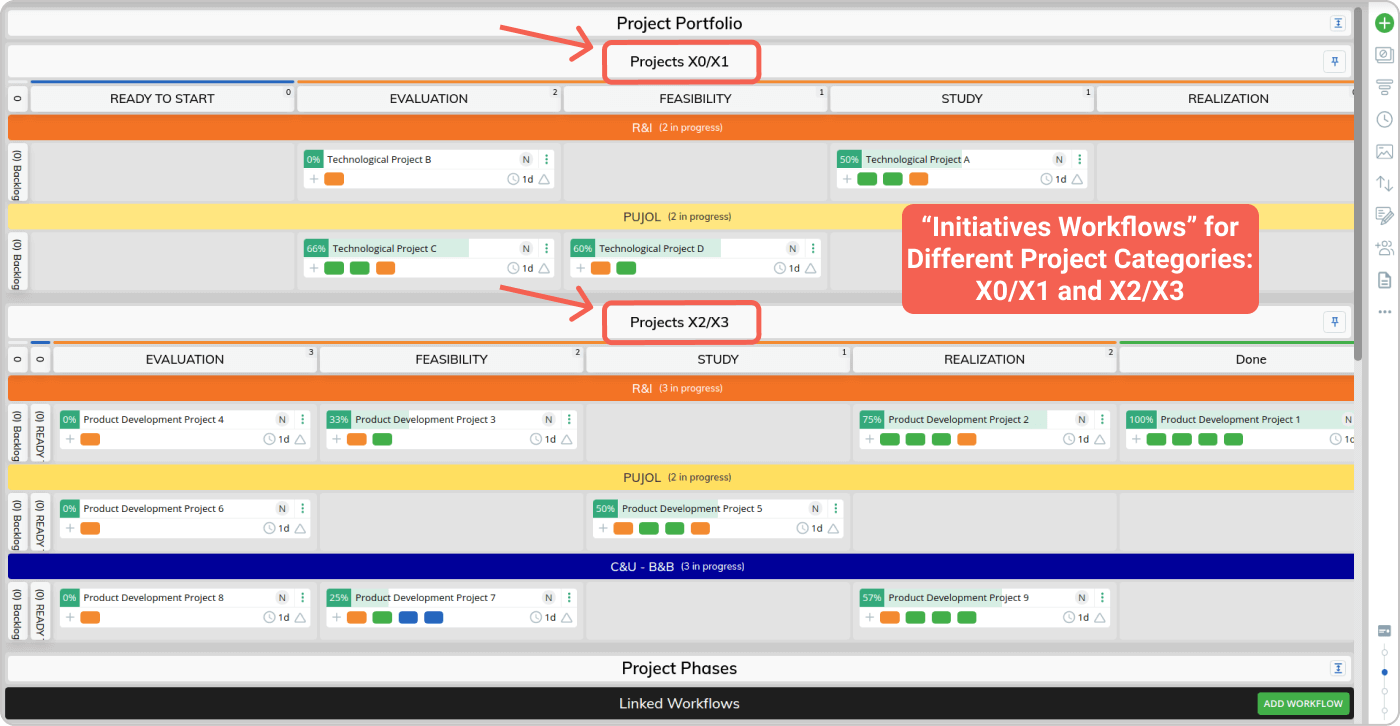 R&D project portfolio visualized across key development phases, with projects connected to their deliverables through parent-child links
Linked workflows connect the portfolio to every team
Bft linked the boards of its mechanical, electronic, software, firmware, operations, and other teams to the portfolio board. Each deliverable is broken into epics, such as mechanical design, electronic design, customer qualification, and certification tests. Teams then break each epic into tasks in joint planning sessions. Each engineer owns their tasks from "Requested" to "Done." When a task is finished, the progress of its epic, deliverable, and project updates automatically.
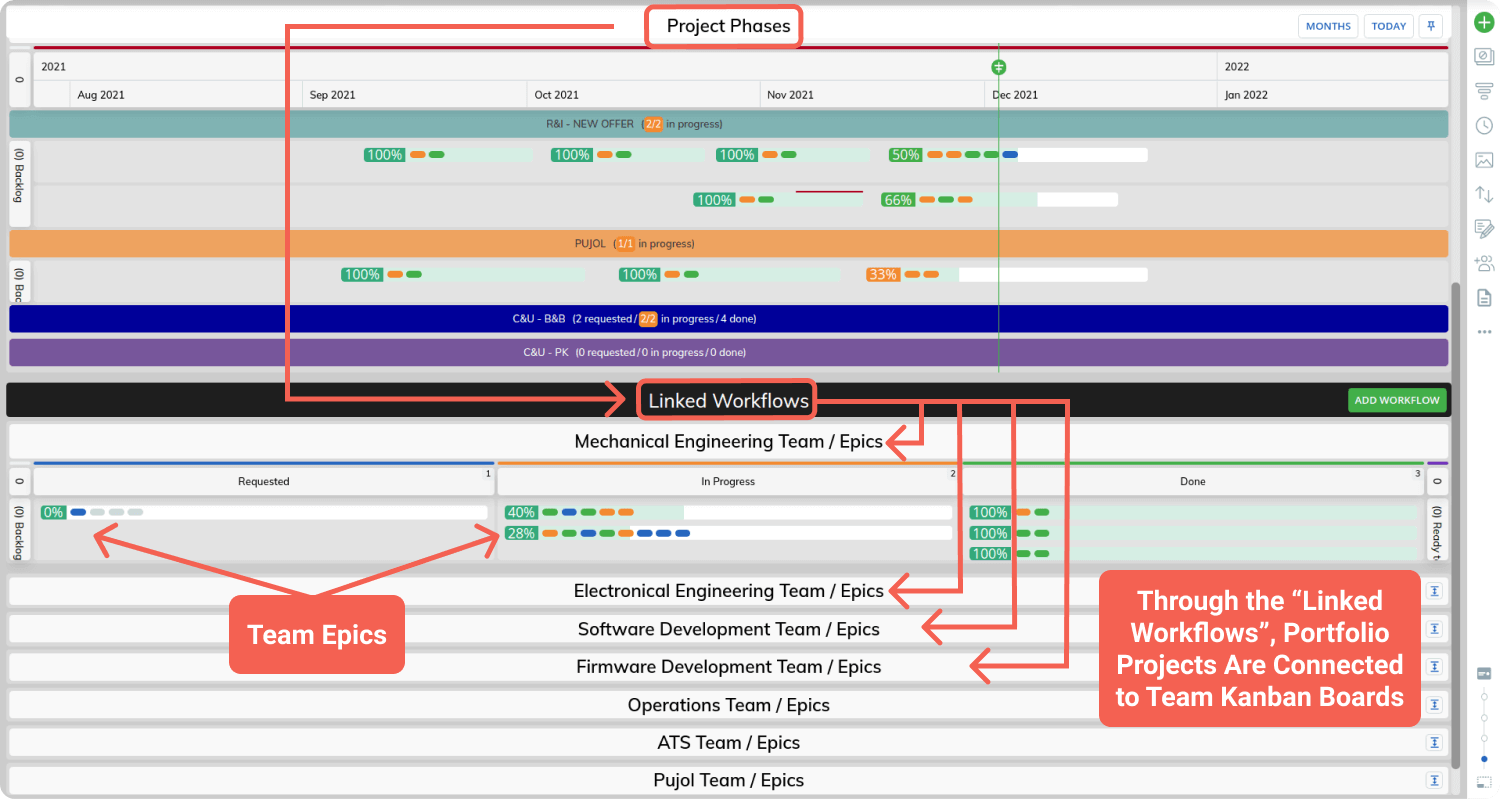 Linked workflows connect portfolio-level projects with engineering team execution, creating visibility from strategic planning to day-to-day work
Blockers and service levels in plain sight
When a task is blocked, the blocker shows up across every connected board, so it can be escalated to management quickly. Service level expectations on in-progress work show when tasks take longer than expected, and the team decides together what to do.
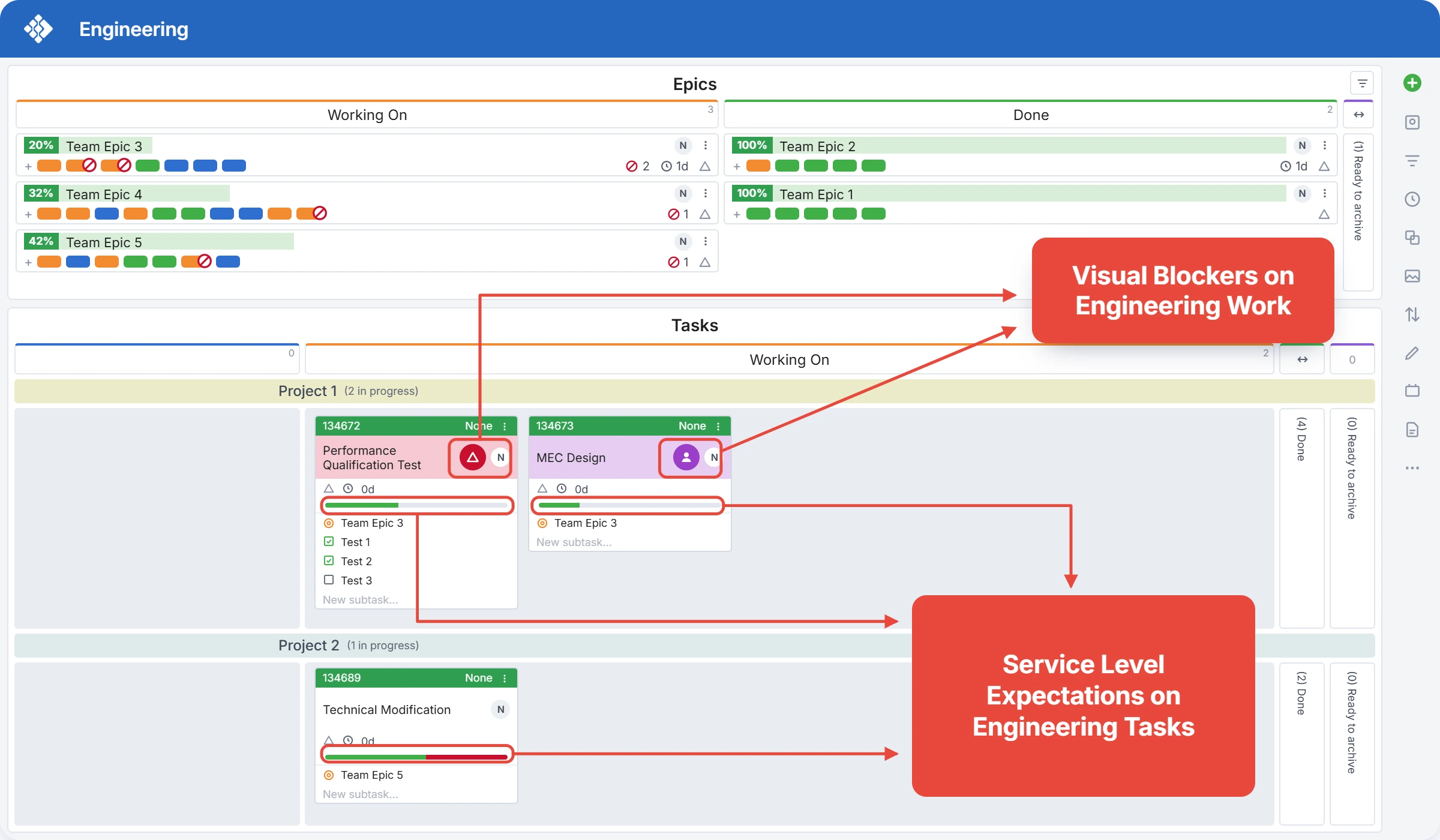 Visualizing work blockers and service level expectations on engineering team boards
The impact: From scattered plans to a connected R&D portfolio
Bft's R&D group achieved:
- Full portfolio transparency. All 30 projects, their stage, and their business area are visible in one place.
- Every task linked to its project, so engineers see how their work contributes to the portfolio.
- Visible dependencies between projects, teams, and external vendors that supply electronic and mechanical parts.
- One standard flow across more engineering teams than before.
- Faster escalation of blockers to the right people.
- More ownership and less stress, as reported by the teams.
- Broad adoption, with about 100 people using the platform.
Next, Bft plans to use its growing workflow data to track cycle time, throughput, and blockers, with the goal of reducing lead times. Over time, it aims to replace estimates with Monte Carlo forecasting, and to automate parts of its engineering process with business rules.
Implemented with O-nami
O-nami helps companies gradually build agility and resilience to deliver products and services sustainably. It focuses on lasting change in behavior, not training for its own sake, drawing on deep experience in Lean, Agile, coaching, and facilitation. o-nami.consulting



