SSOE Group is a global project delivery firm for architecture, engineering, and construction management, with more than 20 locations worldwide. It designs facilities and processes for semiconductor, automotive, high-tech manufacturing, chemical, pharmaceutical, energy, food, healthcare, education, and retail clients. Its mission is to make clients successful by saving them time, trouble, and money. To deliver on that, SSOE set out to adopt Lean Project Delivery across the company.
The challenge: Teams spread across locations, tools, and time zones
Distance made it hard for SSOE's teams to see what colleagues were working on, whether they needed help, or how to support each other. That led to gaps in communication, duplicated work, and rework.
The tools added to the problem. Some people used free online tools such as Trello, others used physical boards, and many used nothing shared. As a result:
- No overview: no one could see a team's or division's total workload, project status, or free capacity.
- Wasted effort: rework, duplicated work, task switching, and time spent searching for information went unnoticed.
- Uneven workloads: whoever received a request had to drop what they were doing and handle it, even if it didn't need their expertise.
What changed
A narrow, deep pilot before a company-wide rollout
SSOE chose the Kanban method as its company-wide approach to managing work, the first step toward Lean Project Delivery. It started with a two-day pilot workshop for a group of architects and designers, studying what worked before rolling it out further. The pilot went well, and junior staff in particular reported learning more and working on a wider range of tasks. After evaluating several platforms, the pilot group moved onto Businessmap.
Training first, then teams design their own boards
Before logging in, each team completed a one-day internal training on the Kanban method and Lean principles. Teams then mapped their workflows on physical boards and recreated them in Businessmap. Each team was free to adapt its board, adding columns, swimlanes, and color coding to match how it actually works, rather than following a fixed company template.
Internal Kanban coaches support every team, encouraging small, gradual improvements rather than big changes that cause a dip in performance. SSOE also shares coaching material on an internal SharePoint site and runs "Lean Coffee" sessions for questions about Kanban and the platform.
"The intuitiveness of the application resulted in a shorter learning curve for new users. The implementation team uses the knowledge base regularly to assist users within the company." | Leslie Accardo, PMP, LEED AP BD+C, former Quality Systems Manager
Templates and links that cut wasted effort
Card templates make repetitive work fast and consistent. For example, a "Checking" template holds the full quality-control checklist, so verification steps are clear every time. Links on each card point to SSOE's internal document management system, so people find the documents they need right away.
Daily huddles around the board
Fifteen-minute daily huddles quickly became part of the working day. Project managers, project leads, engineers, designers, and managers meet around the board to discuss work in progress and bottlenecks. Weekly replenishment meetings and monthly retrospectives complete the feedback loop.
"The daily connect through the huddles allows the sticky points of project work to rise to the surface quickly, now identified for immediate attention." | Jourdan Schermerhorn, AIA, PMP, Senior Project Manager and Mexico Design Manager
Measuring progress with the Kanban Maturity Model
About three months after training, each team completes a Kanban Maturity Model assessment. The assessments were meant to give coaches a baseline for measuring progress. They proved just as useful to department managers, showing where their teams could improve. Work types in Businessmap help gather metrics for different kinds of activity.
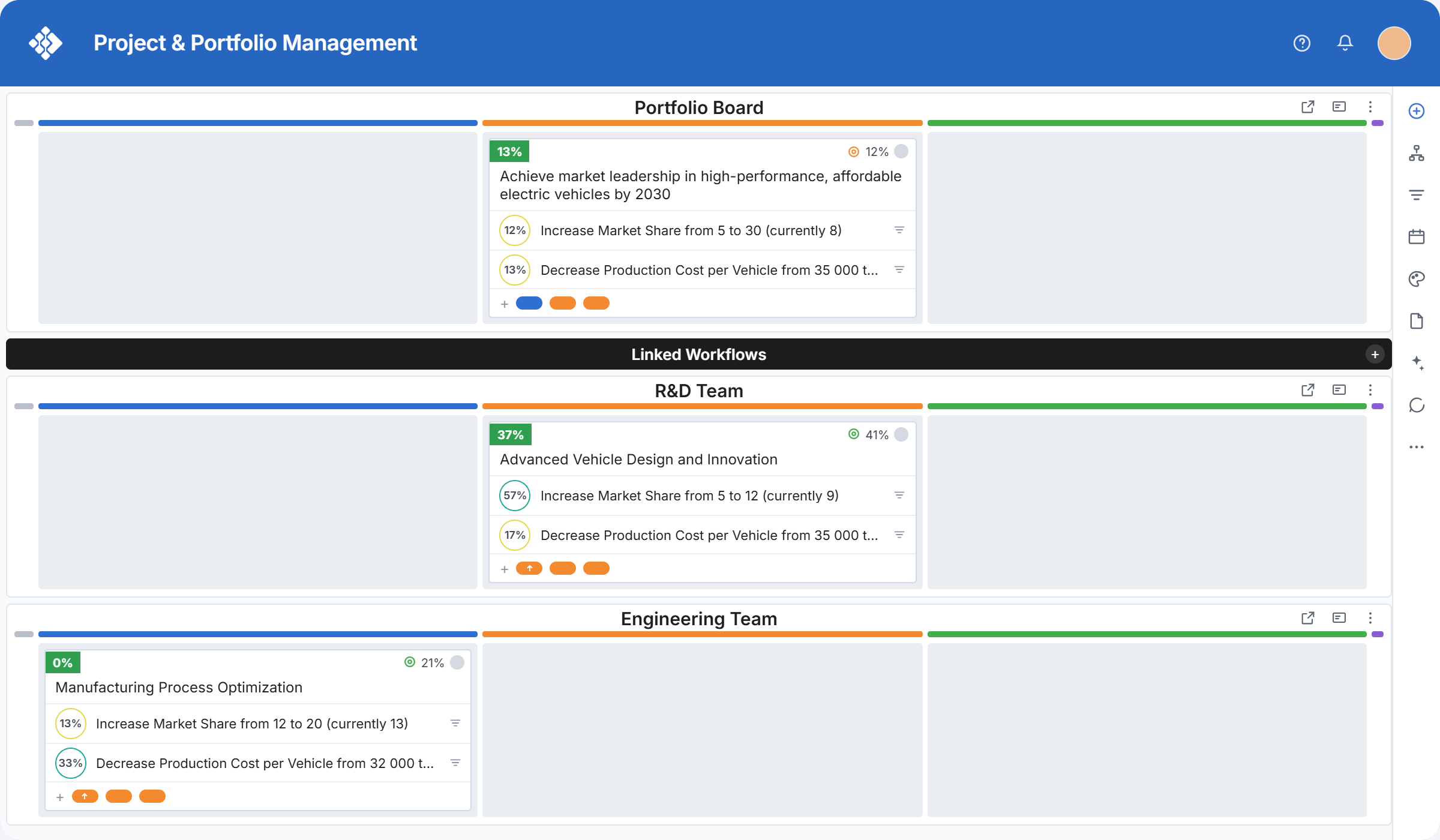 A project and portfolio management board visualizing linked department boards
The impact: Transparent work and a shared sense of "our work"
Across the company, SSOE achieved:
- Operational transparency. Every team's workflow and workload is visible, which improved coordination and scheduling between the stages of a task.
- Less waste. Rework, duplicated work, task switching, and searching for information became easy to spot and remove.
- Better use of people. Leaders see who has capacity, so specialists can hand routine tasks to colleagues and focus on work that needs their skills.
- Growth for junior staff, through more opportunities to take on new tasks and learn from mentors.
- Stronger collaboration. Some teams added a "lessons learned" column to share improvements and successes, and teams think in terms of "our work" instead of "my work."
Next, SSOE plans to move from division-level boards to project-level flow management. Projects will sit in a Portfolio Workspace, linked to work on each discipline's board, so project managers see the status of all divisions' work in real time on a single board.



