BMWC Constructors is an American industrial construction company that has taken on demanding projects for more than six decades. It specializes in pipe fabrication and installation for aerospace, biotechnology, pharmaceutical, power generation, semiconductor, oil and gas, refining, and chemical clients. BMWC is a Lean, process-driven company, and most of its project managers are also owners. Its Western Region was the first to adopt Businessmap.
The challenge: Phone calls, emails, and "he said, she said"
A typical BMWC job involves many people across a fabrication shop and job sites spread over several cities and states. Communication ran on phone calls and emails, and work history was tracked in Excel. This caused constant problems:
- Issues reached the wrong person: if an assembly was missing a part, someone called or emailed purchasing. But with no central purchasing team, the right contact changed for every job.
- Little transparency: confusion built up at every stage, from shop drawings through fabrication and installation to quality control.
- Disconnected job sites: each site had little idea what the others were doing.
"Our main goal in adopting the Businessmap software was to create transparency and increase visual communication throughout our region."
What changed
From one project to five departments
A design partner introduced BMWC to Businessmap on a large project with a tight schedule, where the teams couldn’t afford to wait for traditional handoffs. After seeing its value in design, BMWC’s project manager used it to track the construction phase too. When that worked, the team extended it upstream and down: estimating, BIM/CAD design, fabrication, installation, and quality control.
Nine months later, five departments were using Businessmap:
- Fabrication shop board: used by the whole Western Region to track every pipe spool from "issued for fabrication" drawings to delivery to the field.
- Estimating board: proposals and estimates for each scope of work.
- Field board: construction, testing, and commissioning.
- BIM/CAD board: isometric drawings produced for fabrication, now archived by job number, so each job’s full history is in one place instead of Excel.
Because the boards are web-based, every site sees the same data in real time, which is impossible with physical boards across several states.
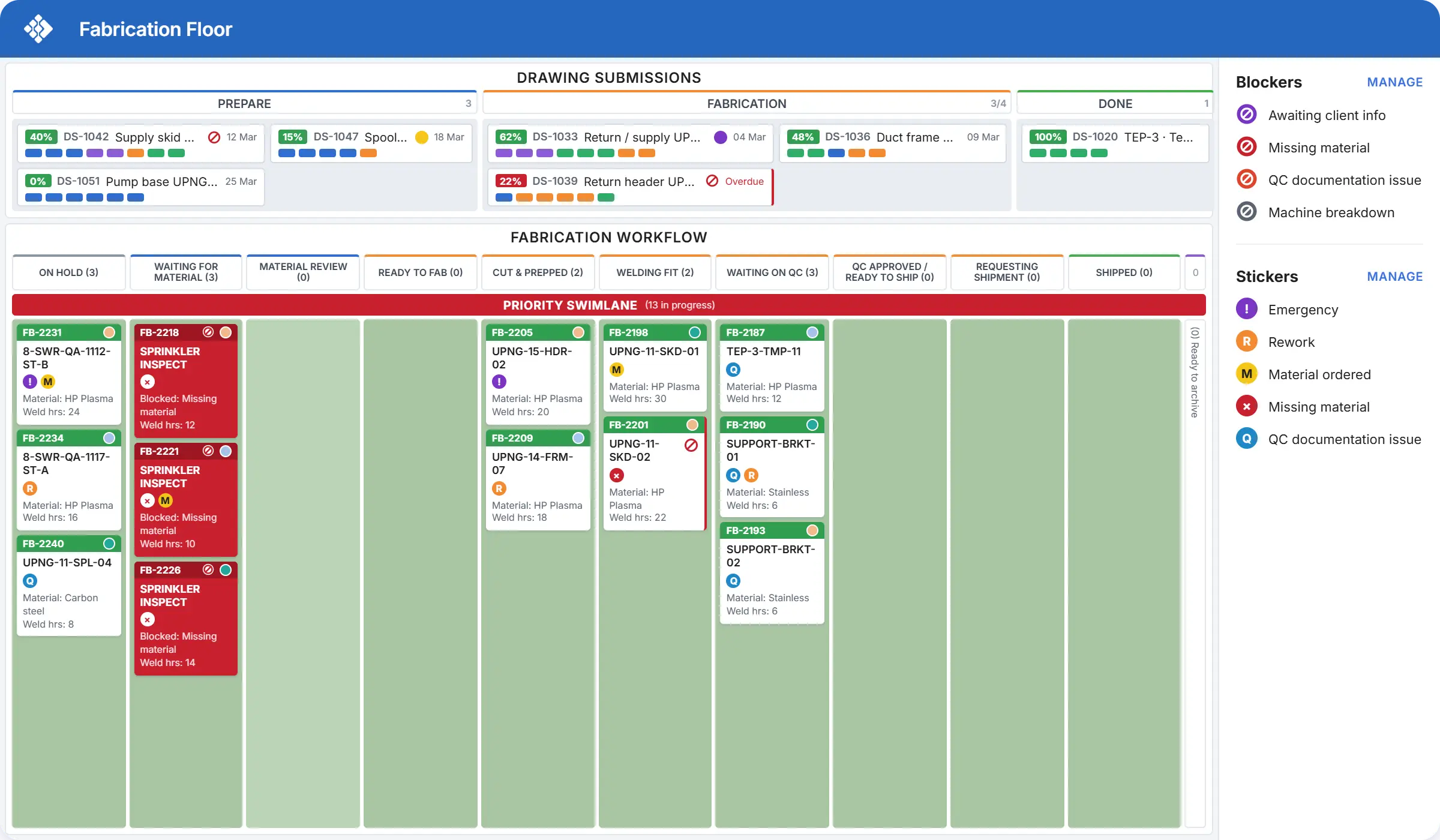 Visualization of a Fabrication Shop board with stickers and blockers
Automation that sends problems to the right person
Automation became BMWC’s most important feature. On the fabrication board, every production stage has clear roles and responsibilities, and there’s a sticker or blocker for every common cause of delay, such as "Missing Material" or "Documentation Issue." BMWC set up 15 business rules, including:
- Missing material: a "Missing Material" sticker automatically notifies the person responsible.
- Job site alerts: each card is tagged with its job site, so any sticker or blocker notifies that site’s project team.
- Due dates: cards move to a priority lane when completion is within 7 days, and the teams involved are notified when it’s within 2 days.
- Linked blockers: when a subtask is blocked, its parent is blocked too.
- Checklists: a notification goes out when a walk-down checklist is complete.
Rules also connect the job site board to the fabrication shop board, so when work reaches a certain stage at one location, the other team knows straight away.
Custom fields for forecasting
Custom fields record details specific to BMWC’s work, such as material type (high-purity tube, high-purity plastics, carbon steel) and weld inches. The shop splits its data by production area to see its backlog and plan staffing, and exports the data to forecast capacity. Card templates with preset fields make sure no detail is forgotten.
A 15-minute daily standup across sites
A representative from each job site joins a 15-minute daily standup, in person or by video. The team discusses blockers, questions, and concerns, so surprises and recurring issues are caught early.
The impact: More work finished, faster
A manager called it "the most productive thing to take place within our division in many years." The data supports that:
- More work finished every week. After the first few weeks of setup, 40–60 new cards entered the system each week, and the number finished rose steadily regardless of how much came in.
- Shortest cycle time ever. Cycle time rose briefly as people learned the tool, then each peak was lower than the last. By mid-February, about four months in, BMWC recorded its shortest cycle time to date.
- Problems solved faster across sites, through blockers, comments, and automatic notifications.
- Better staffing decisions, based on backlog data for each production area.
- One complete history for every job.
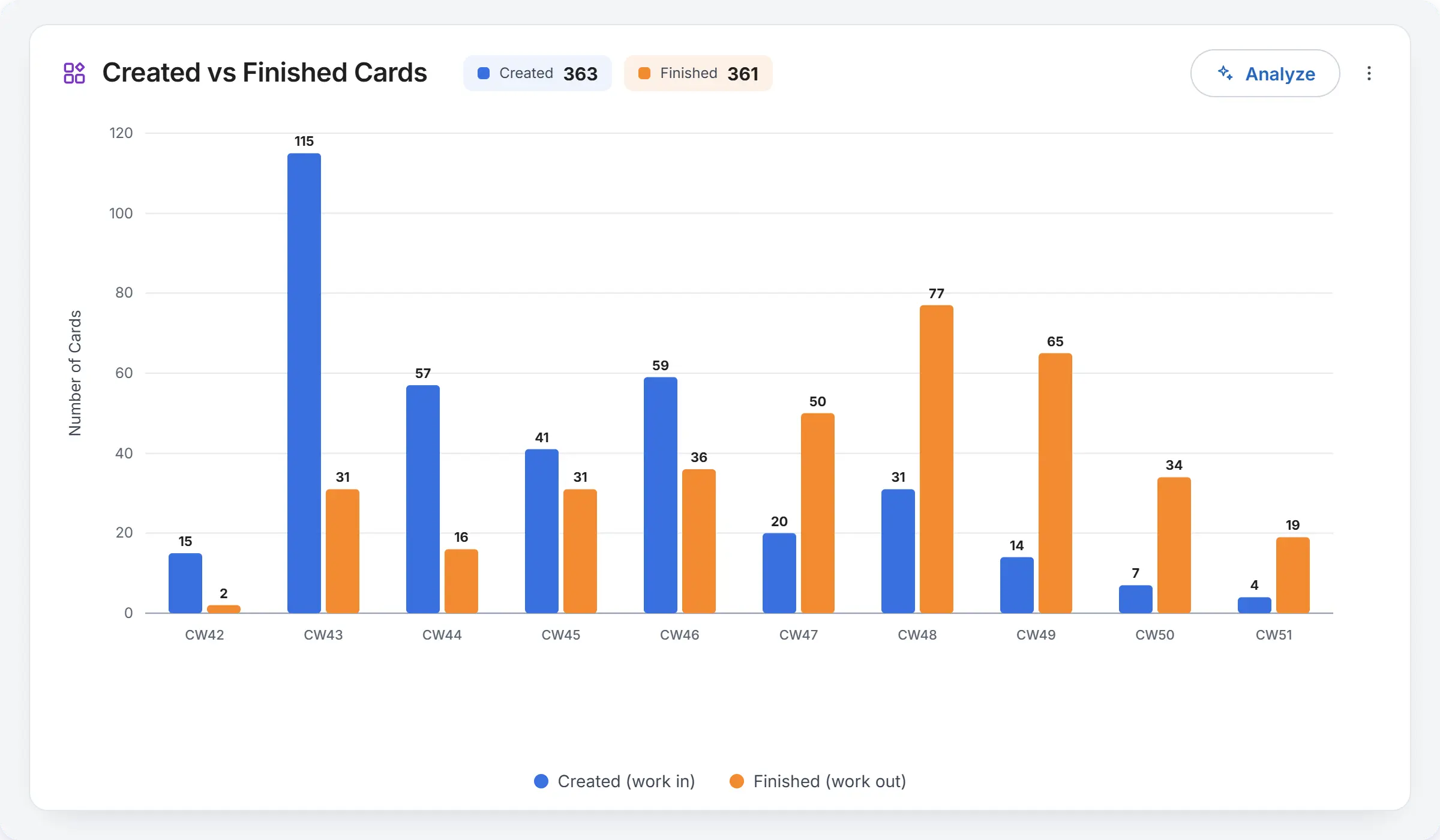 Visualizing created vs. finished cards chart using Boards Flow Metrics widget in Businessmap
All of this came from making work visible and improving communication, without major organizational changes. Next, BMWC plans to use its analytics to find bottlenecks, benchmark capacity, and use Monte Carlo simulations to forecast and estimate more accurately.



