ULMA Handling Systems designs, builds, and installs automated material handling systems, from small warehouses to complex distribution and manufacturing centers. Its solutions automate the full flow of goods, from receiving through storage, sorting, and order picking to dispatch, managed by its own U·Mind warehouse management software. ULMA also builds baggage handling systems for airports. With more than 400 employees, it operates from Oñati, Polinyà, and Aldaia in Spain, and from Serris (France), Arnhem (Netherlands), São Paulo (Brazil), and Lima (Peru).
The challenge: Long, complex projects that change at every stage
A typical ULMA project lasts one and a half to two and a half years. It involves industrial engineers, software developers, technicians, many stakeholders, and suppliers, all under tight deadlines, regulatory requirements, and high quality expectations.
Requirements are rarely fixed at the start. Scope changes can arrive in any phase, and each change affects the technical solution, deadlines, budget, supplier agreements, everyone's workload, and the planning of other projects. Meeting milestones without major budget overruns was a constant challenge.
By 2019, ULMA had set up a Project Management Office, trained its project managers in PMBOK-based processes, and given them established tools. Even so, it lacked:
- Visibility: no clear view of overall project status.
- Fast communication: no good way to raise unexpected events and daily issues.
- Quick decisions: slow decision-making was adding to delays.
Adding more rules wasn't the answer, because workloads were already high. ULMA needed simpler practices and closer cooperation between its business areas.
What changed
Physical boards showed what was missing
In April 2019, senior management started bringing agile practices into project management. Five or six pilot projects got physical boards and daily team meetings, and communication within those teams improved quickly.
The limits soon showed. People traveling to installation sites in other cities, countries, or continents couldn't see or update the boards. People working on several projects had tasks spread across boards, or not shown at all, so no one could see their real workload. Prioritizing and handling dependencies between areas was hard, and people on several projects couldn't attend every 15-minute daily meeting, so they stopped going.
Clear goals and a careful starting point
In October 2019, ULMA set its objectives:
- See project status at every level: business area, project, and multi-project
- Work in a consistent way
- Make decisions faster
- Meet project deadlines
It also wanted a process of its own, suited to its culture, not a method imposed from outside. Starting with one area would have improved that area alone and done nothing for dependencies between areas. Starting everywhere at once risked too many problems at the same time. So ULMA:
- Started with a few projects whose teams were keen to adapt Kanban to ULMA's work.
- Gave every area enough visibility of its own work and the projects it supported.
- Shared progress through Barnekom, its internal communication channel.
Business agility expert Teodora Bozheva trained project managers, area managers, PMO members, and key project staff. The CEO and PMO Director helped shape the approach.
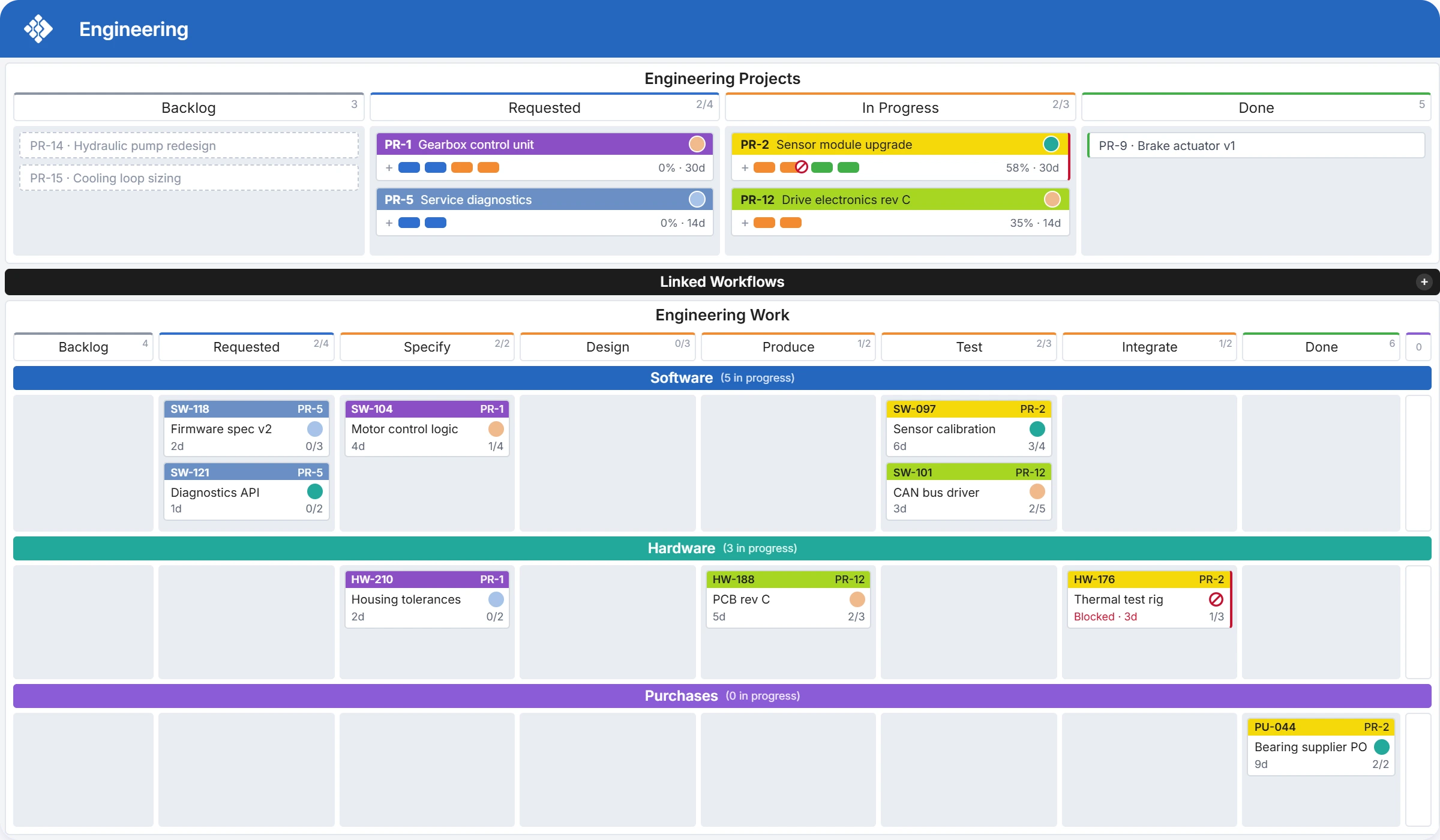
Boards for every area and every project
ULMA chose Businessmap so everyone could reach the boards from anywhere. Boards were designed for each area's type of work and in the company's own vocabulary:
- Area boards: each person's work across all projects, who is doing what, work in progress against capacity, and fast warning of blockers.
- Project boards: the full project lifecycle, the handoffs between phases, agreed policies for each handoff, and blockers from any area surfacing at project level straight away.
- Multi-project view: how all projects are progressing together.
ULMA's existing project management process gained clear policies for managing workflow, laying the foundation for a shared decision-making framework. Businessmap coached the project managers and teams to build the new habits. In line with Kanban, ULMA started from its existing processes, with no drastic changes to management or roles.
ERP integration made it work at scale
Businessmap is integrated with ULMA's ERP. Project cards are created automatically from the ERP, data stays in sync, and Businessmap data flows back for cost management. With thousands of cards linked across several levels, creating them by hand would have been impossible.
The impact: Faster, data-based decisions during a crisis
A few months into the rollout, the COVID-19 pandemic stopped work for ULMA, its customers, and its suppliers. Meeting new deadlines and getting fast feedback on project status became more important than ever, and the new way of working proved its value. Within a year, ULMA achieved:
- Visibility at every level: area, project, and portfolio, including progress, blockers, and risks.
- Shared information for managing dependencies between areas, projects, external stakeholders, and suppliers.
- A clearer picture of capacity, real development times, and the most common blockers.
- A consistent way of working and shared management policies across all locations.
- Reliable data flowing continuously between Businessmap and the ERP.
- Stronger teamwork, with people working together to solve problems on complex projects.
ULMA credits much of this to leadership: the CEO, PMO Director, and area managers were directly involved from the first day.



