Sensata Technologies is a global industrial technology company that makes sensor-rich solutions, with offices in the US, Japan, Bulgaria, and other countries. In Bulgaria, the Mechanization department designs and assembles production lines, then installs and maintains them. Its software development team writes the software behind those lines, handling both new development and support for lines already running.
The challenge: A team "managed by escalations"
At the start of 2020, the software team was under heavy pressure. Requests poured in from multiple projects and internal customers, and the team didn't have the capacity to meet them all. The workflow was uneven, and in practice, work was "managed by escalations."
- Almost everything was late: in March 2020, nearly all tasks were overdue.
- Plans didn't hold: unplanned support requests kept arriving, so project plans quickly fell apart.
- Constant task switching: people jumped between requests, which slowed everyone down and raised stress.
Team supervisor Dimitar Panayotov, supported by Mechanization Team Manager Georgi Kirilov, set out to make delivery predictable and gradually increase throughput using the Kanban method. Kanban coach and trainer Ivaylo Gueorguiev guided the team.
What changed
From a physical board to Businessmap over one weekend
The team first built a large physical Kanban board from four whiteboards on the workshop wall. Then COVID-19 hit, and everyone whose presence on site wasn't essential had to work from home. The team moved its Kanban system to Businessmap over a single weekend, choosing it for its rich features, ease of use, and analytics.
Two workflows, with queues made visible
The board shows two workflows:
- Support: from request through debugging and validation to done, with separate lanes for incidents and standard support.
- Development: from ready-to-start through design, debugging, and validation to done, with lanes for each type of work: upgrades, new product development, HMI and traceability, robots and simulations, vision systems, improvements, and reporting.
Queues where work waits, such as "Debug done" before validation, are shown as their own columns, so the team can spot where time is lost. Capacity per lane shifts as priorities and demand change.
Four classes of service set clear priorities
Each card's color shows its class of service, based on the cost of delay:
- Expedite (red): line stoppages, escalations, and critical project work. These can override WIP limits, and managers decide when they apply.
- Fixed date (yellow): work with a deadline, started early enough based on how long similar work has taken.
- Standard (green): normal work, handled first in, first out.
- Intangible (blue): low-priority work, done when there's capacity.
Senior management's project priorities sit in a "board rules" lane at the top of the board, one priority per slot, so there's never confusion about what comes first.
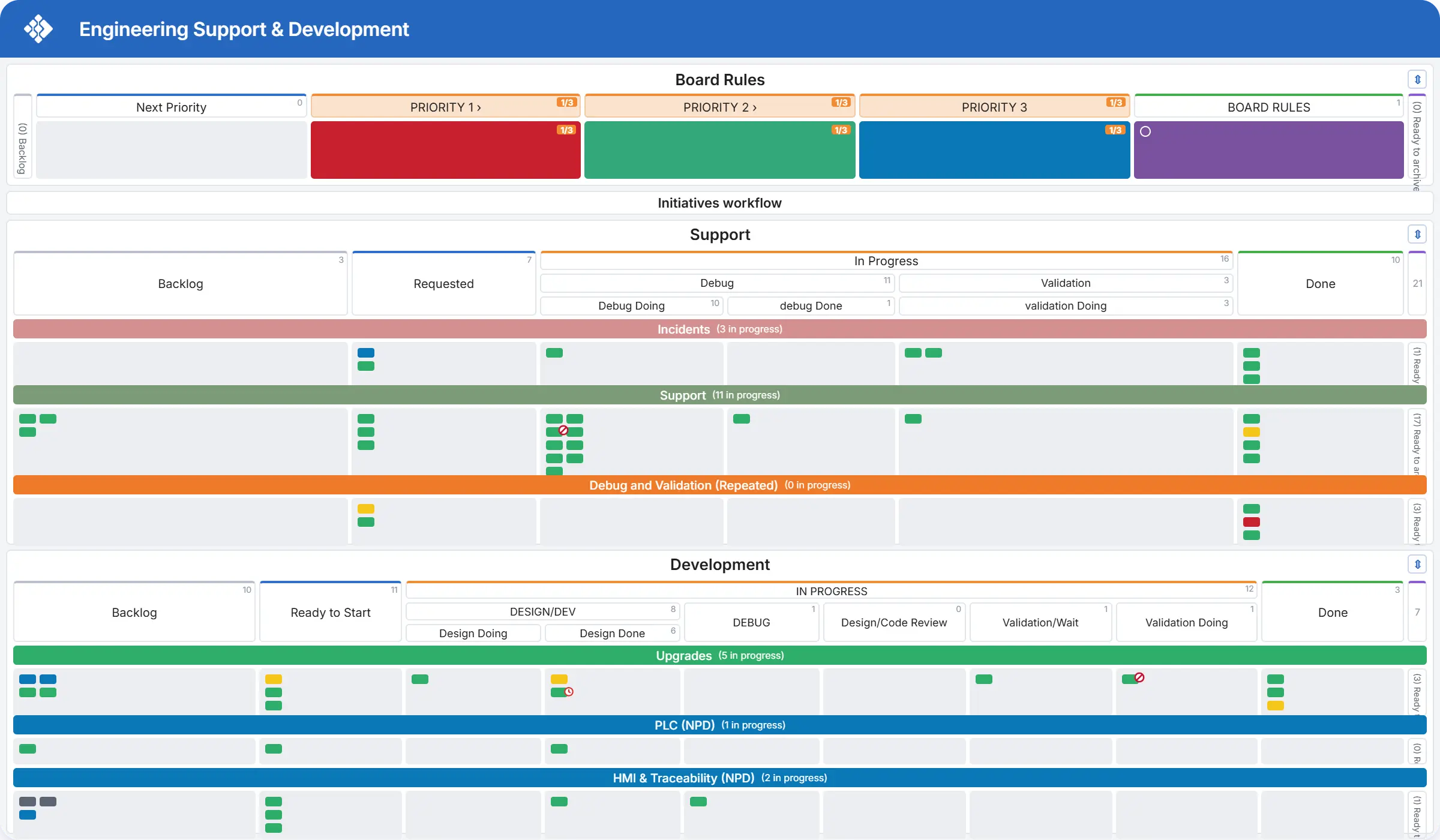 A workflow board showing "Board rules" and policies workflow, a Support, and Development workflows in one view
A WIP limit of three, now usually two
To stop constant task switching, each person works on at most three items at a time. Keeping to this was hard at first, but the benefits soon showed: better focus, shorter cycle times, less pressure and fatigue, and a happier team. Today most people work on two items at a time, reaching three only when an expedite item arrives.
Shorter meetings, better alignment
Daily meetings started at 30 minutes but often ran to an hour. Within a few months they averaged under 30 minutes. The division manager and project managers who attend now use the time saved to align engineering and assembly work with the software team's. Retrospectives every two to four weeks drive improvements, such as systematic code reviews to reduce defects.
The impact: More delivered, with fewer people
Between March 2020 and March 2021, team capacity fell by about 25%. Hours were reduced during the pandemic, some people left, and new members needed time to get up to speed. Even so, the team achieved:
- 2.5× throughput. The average number of requests completed per month rose from 17 (March–May 2020) to 43 (March–May 2021).
- Overdue work nearly eliminated. By May 2021, the dashboard often showed no overdue cards at all.
- Balanced support and development work, adjusted to changing demand.
- Better alignment with company priorities, as work follows the board rules set by management.
- Less stress, with a steady, predictable flow of work.
The team was open about what still needed work. Standard requests were not yet as predictable as urgent and fixed-date ones. The data also showed issues beyond the team: about 6.3% of high-priority tasks waited one to two more weeks for validation, and about 9.5% of tasks were escalated to a higher priority partway through.
Next, Sensata plans to extend Kanban to all teams and to the whole value stream, connecting design, procurement, and production boards to a portfolio level. The goal is to increase the number of machines and production lines delivered each month or quarter.
Implemented with European Software Institute (ESI) – Center Eastern Europe
ESI CEE is a Gold-tier Businessmap Certified Partner based at Sofia, Bulgaria. For more than 15 years, it has helped banks, fintech, software, and manufacturing companies improve business results through Kanban, Agile, OKRs, and the Balanced Scorecard. esicenter.eu



