Encoparts, based in Piracicaba, São Paulo, supplies parts and components for "Yellow Line" equipment: the heavy machinery used in construction, mining, and earthmoving. Its range covers almost 80% of the parts available on the market. It operates in Brazil, the US, Chile, Peru, Colombia, Ecuador, Australia, Canada, and Mexico. Its customers include mining companies, sugar and energy producers, construction firms, and public institutions. This story follows its International Purchasing unit in the US, which sources parts for the Global Sales and Brazil Purchasing teams.
The challenge: Missed deadlines in a complex purchasing flow
International purchasing at Encoparts is complex. Parts may be bought, manufactured, or assembled. They come from internal US and external suppliers, each with different negotiation and payment terms, and every order must comply with foreign trade law. Each order passes through search, negotiation, ordering, finance, supplier follow-up, receiving, and approval.
All of this ran on Excel spreadsheets, with controls that only kicked in after something went wrong. This caused three problems:
- Missed deadlines: the unit often missed delivery dates for Global Sales and Brazil Purchasing, and had no record of how often or why.
- Information chaos: several people asked for order status, supplier position, and reasons for delay at the same time. Information was duplicated or inaccurate, and problems went unsolved.
- No view of capacity: the team couldn't see how much work it could take on.
The business cost was real. Missed deadlines hurt Encoparts' on-time-in-full (OTIF) targets for parts delivery. In critical cases, Caio Grigorine said, they led to financial losses through canceled orders.
What changed: The Lean/Agile Transformation Journey
A step-by-step Kanban rollout
With its implementation partner, the purchasing team introduced the Kanban method using STATIK, a structured approach to introducing Kanban. The rollout followed four stages:
- Understand the current state: map the process as it was, its main barriers, and what the team needed.
- Build a Lean/Agile mindset: train the team in Lean thinking, OKRs, and Kanban, and experiment with new practices.
- Prepare the platform: learn Businessmap and set up monitoring.
- Go live: design the new workflow and its policies, test it in a simulation, decide go or no-go, and launch.
The new system was running in under six months.
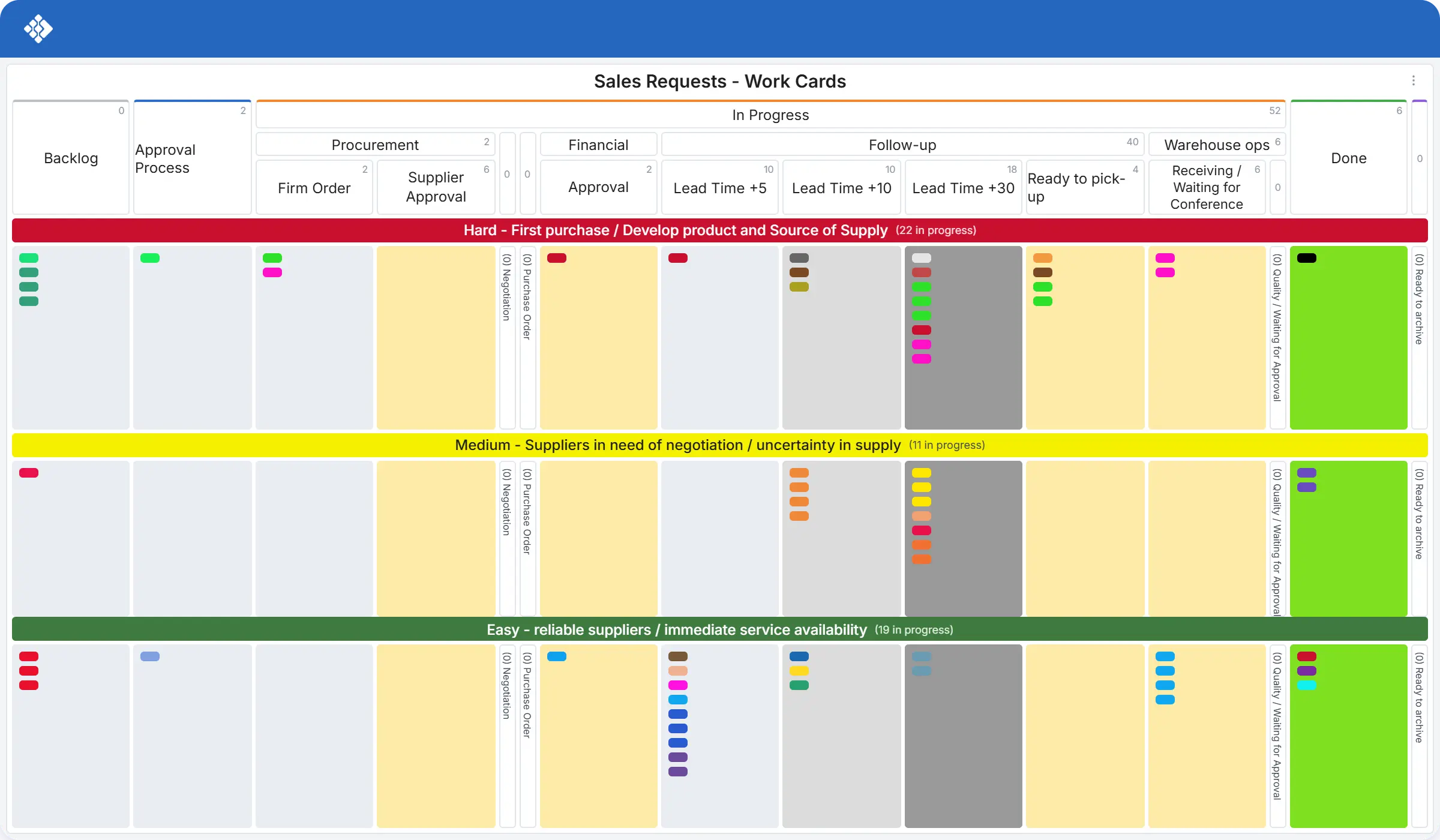 Visualizing a partial workflow for the demands for parts distributed among three service classes (Hard, Medium, and Easy)
Value stream mapping exposed hidden waiting time
The team mapped every step in its purchasing flow and separated work that adds value from "necessary waste." Necessary waste means steps such as approvals, quality checks, and waiting for input from other teams, which add no value but can't be skipped. This showed where orders spent most of their time waiting.
Three classes of service set priorities
Every order is sorted by difficulty:
- Hard: first-time purchases, or new products and supply sources
- Medium: suppliers that need negotiation, or uncertain supply
- Easy: reliable suppliers with parts immediately available
Card colors show which supplier is fulfilling each order. The team now handles complex orders faster, which helps it meet its service level and OTIF targets.
Orders arrive by email and break down by supplier
Global Sales and Brazil Purchasing send orders by email straight into Businessmap, so every order is entered the same way and keeps its full history. Each sales order is broken into child cards by supplier, material type, and region, and stays in progress until every child card is done. Deadlines on cards trigger alerts before critical dates. Comments hold technical data and customer requirements, so the team has complete information. Exit criteria for each step mean work moves forward only when it's ready.
Flow metrics in one dashboard
A central dashboard tracks lead time, cycle time, blocked time, throughput, flow efficiency, and work in progress. A sales order chart shows which orders are on time and which are overdue. Service level expectations flag overdue child cards, and the Workflow Performance Summary compares each metric with the previous period.
As Pedro Bert, International Purchasing Coordinator, put it:
"The Businessmap software platform helped us to measure and quantify data transparently, making it visually easier and more practical."
The impact: Measurable flow in the first two months
Within its first two months of tracking work in Businessmap, the International Purchasing unit achieved:
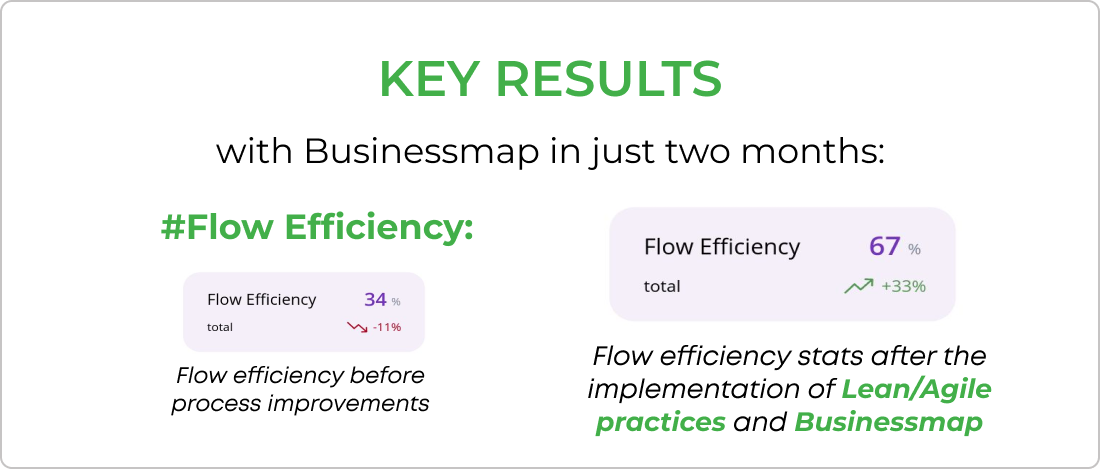
- Flow efficiency up from 34% to 67%. Orders spend far less time waiting and more time being worked on.
- A stable 12-day average cycle time across 152 work items.
- Kanban live in under six months, from first workshop to go-live.
- Clear data on overdue orders, including causes and corrective and preventive actions.
- Better deadline performance, with lead time and cycle time visible to everyone.
- Faster handling of complex orders through classes of service.
Next steps
Next, Encoparts plans to set rules that move cards automatically and to map its external dependencies. It also plans to bring warehouse operations (receiving, quality, and dispatch) onto the platform, connecting the full value chain from purchase to customer. Kaizen improvement events are already planned.
Implemented with Interflow
Interflow specializes in strategy and business management by projects. It helps companies improve performance using the Balanced Scorecard and the Rummler-Brache methodology.



