Why Managing Multiple Projects Requires a PPM System (Not Just a Project Tool)
Traditional project tools like Gantt apps, task boards, and spreadsheets work fine when you have one project and a small team. But modern companies manage dozens or hundreds of projects at once, and once multiple teams start delivering faster, the hardest problem becomes getting the bigger picture.
Here's why multi-project delivery can fail without a centralized software to ensure that all delivery contributes to the right goals:
- Fragmented visibility: Project managers operate in silos, making it impossible to see how work across teams connects or conflicts.
- Overloaded resources: Teams unknowingly take on work they don't have capacity for until bottlenecks appear.
- Conflicting priorities: When strategy isn't visible across teams, work is driven by urgency rather than value.
- Unmanaged dependencies: A blocked task in one project silently delays three others.
- Inconsistent reporting: Leadership receives outdated, inconsistent, or contradictory status updates.
- Poor forecasting: Without data, probability forecasting, and scenario planning, schedule changes become guesswork.
A modern PPM system solves these problems by creating a shared reality across all projects, portfolios, and teams, allowing organizations to coordinate work.
What to Look for in PPM Software for Managing Multiple Projects
Multi-project work requires a platform that scales across teams, programs, and portfolios.
Below are the essential capabilities for evaluating any PPM solution.
| Key Capability |
What to look for |
| Multi-Project & Multi-Portfolio Visibility |
Hierarchies connecting tasks → projects → programs → portfolios Roll-up status across teams and departments Real-time dashboards End-to-end value stream visualization |
| Cross-Project Dependencies |
Visualize dependencies Identify cross-team blockers Track how delays impact portfolio timelines Link related work across boards automatically |
| Resource & Capacity Management |
Resource visibility across all teams Ability to detect overload early Portfolio-level constraint analysis |
| Scenario Planning & Portfolio Simulations |
What-if analysis Impact modeling for shifts in deadlines or priorities Forecasting based on historical data Portfolio balancing across capacity and strategic value |
| Real-Time Dashboards for Leadership |
Portfolio health summaries Risk heatmaps Confidence indicators Progress dashboards Project interdependency views |
| Risk & Issue Management at Scale |
Roll up risks from projects into programs Visualize blockers and delays Detect bottlenecks via flow analytics Provide early warnings of delivery risk |
| Enterprise Integrations |
Jira & Azure DevOps MS Teams & Outlook Power BI, Tableau ERP & CRM systems Finance and HR systems |
| Scalability & Governance |
Large user bases Multi-layered permissions Workflow customization Enterprise reporting |
Businessmap – Best PPM Software for Managing Multiple Projects Across the Enterprise
Businessmap is an enterprise-grade PPM platform built for organizations managing complex portfolios of projects, programs, and strategic initiatives. Unlike traditional project tools, Businessmap connects work across all levels of the organization - strategy, coordination, and execution - giving PMOs true multi-project visibility.
By combining Lean/Agile flow principles, initiative hierarchies, dependencies, timelines, and AI-driven analytics, Businessmap provides an unmatched system for managing multiple concurrent projects at scale.
Enterprises like BASF, Astra Zeneca, and Grob-Werke use Businessmap to centralize portfolio planning, increase predictability, and streamline cross-team coordination.
Key Features for Multi-Project Management
→ End-to-End Portfolio Visibility
Businessmap connects strategy → portfolios → projects → tasks through:
- Portfolio boards
- Multi-layered project/initiative hierarchies
- Automatic roll-up visibility
- Real-time status icons showing where child items are across workflows
This creates one version of truth for all projects and teams.
Customer Story
AK Gida - Turkey's largest dairy producer, achieved true end-to-end visibility by adopting Businessmap to unify every layer of work, from high-level projects to change requests and daily activities. By structuring their workflows into a clear hierarchy, the CIO and PMs gained immediate, real-time insight into how work moved across the entire value stream.
See how Businessmap enabled this level of end-to-end portfolio visibility. Read the case study↗
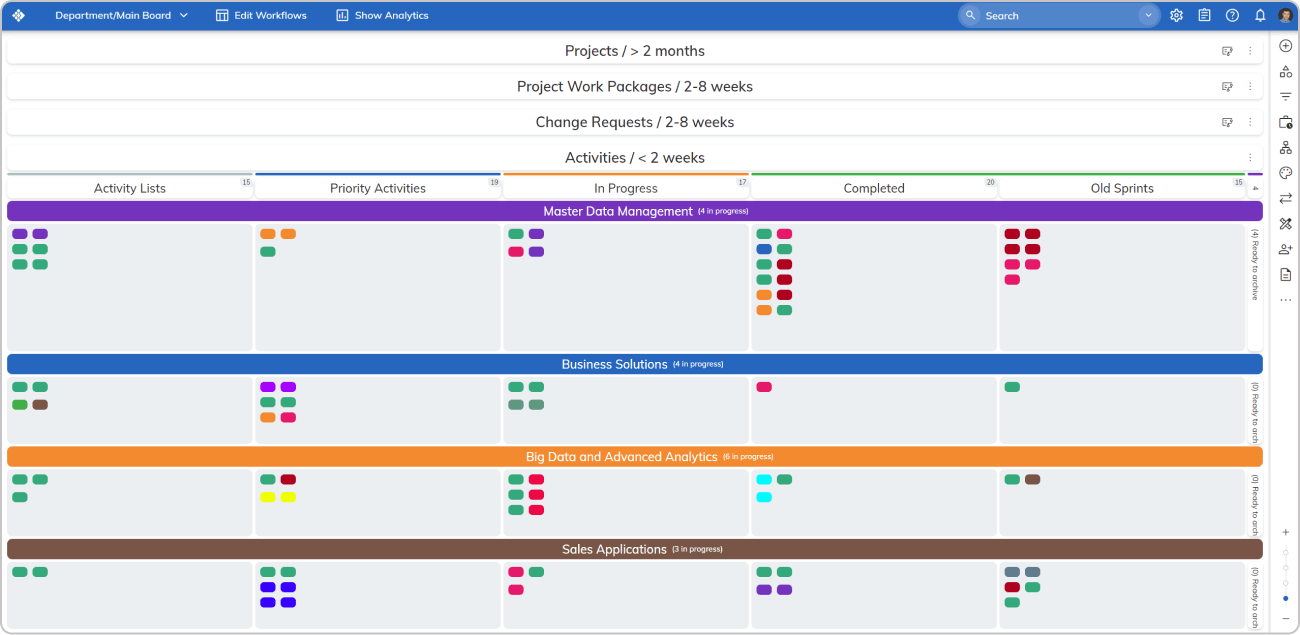 Visualizing IT department’s multiple projects in a central hub in Businessmap
→ Timeline & Gantt-Based Planning
The Planning View works as a dynamic Gantt chart:
- Plan multi-project timelines
- Adjust durations with drag-and-drop
- Link dependencies
- Review planned vs. actual progress
- Ensure capacity-based scheduling
Ideal solution for PMOs handling complex, interdependent workstreams.
→ Portfolio Boards for Cross-Team Alignment
Portfolio boards allow you to:
- Break down large initiatives into smaller, trackable components
- Distribute work across teams
- Visualize dependencies across units
- Maintain big-picture clarity without micromanagement
This is essential for organizations where many teams contribute to the same outcomes.
Discover how a Fortune 500 energy company improved its visibility into strategic goals connected to the work happening across hundreds of teams with Businessmap, resulting in 80% higher visibility, 100+ hours saved, and far better capacity planning.
→ Dependency Mapping
Businessmap highlights dependencies clearly across levels, ensuring PMOs can:
- Identify critical path risks
- Spot cross-team blockers
- Adjust plans before they cause delays
- Dependencies become visible from the portfolio down to individual tasks.
→ Flow Analytics for Predictability
This is where Businessmap outperforms traditional PPM tools.
Built-in analytics help you track:
- Cycle time
- Throughput
- Work in progress (WIP)
- Aging WIP
- Flow efficiency
- Cumulative flow diagrams
- Monte Carlo forecasting
These insights give PMOs early signals of delivery risk and realistic forecasting capabilities.
Customer Story
By embedding explicit policies, WIP controls, and OKR alignment in Businessmap, the Portuguese Postal Service (CTT) created a unified, data-driven execution model. Analytics enabled the organization to replace manual estimates with statistical predictability, improve decision-making, and eliminate waste. As a result, the organization cut lead time in half and boosted productivity by 30%.
See how CTT achieved these results with Businessmap. Read the case study ↗
→ Lean & Agile Workflow Coordination
Businessmap is designed around continuous improvement:
- Pull-based planning
- WIP limits
- Bottleneck identification
- Prioritization through swimlanes
- Team and portfolio cadences
These Lean principles keep multi-project environments stable and flow-based.
→ Frameworks Support
Businessmap stands out for its methodology-agnostic approach, making it ideal for organizations with mixed delivery models, legacy processes, or teams maturing toward Lean and Agile ways of working.
- Lean project and portfolio Management
- Agile workflows (kanban, scrum)
- Hybrid delivery models
- Strategy execution via the Flight Levels concept
→ Powerful Integrations
Businessmap supports deep integrations with:
- Jira & ADO
- Power BI & Tableau
- ERP systems via APIs
- SAP (as proven in BASF's transformation)
This makes it easy to unify delivery data across tools.
Strengths & Ideal Use Cases
Businessmap is best for organizations that:
Manage many parallel projects
- Need portfolio-level visibility over multiple teams
- Struggle with dependencies and resource overload
- Require accurate forecasting
- Want to align strategy with execution
- Operate in hybrid or Lean/Agile delivery models
Pricing & Trial Options
- Demo center
- A free trial on-demand
- Guided demo available
- Enterprise onboarding and training
- Pricing from $8/user/month (annual for 100+ users)
How to Choose the Best Multi-Project PPM Tool for Your Organization
Here are a few important PPM vendor selection criteria to help you compare solutions:
1. Identify your portfolio and coordination challenges
Are you dealing with overload, dependencies, prioritization issues, or simply lack of visibility?
2. Map your multi-project complexity
How many teams, regions, or delivery layers must your tool support?
3. Evaluate integration requirements
Your PPM tool must connect to your existing systems for accurate planning.
4. Assess scalability & governance
Enterprise PMOs need permission layers, automation, and flexible workflows.
5. Validate with a trial or pilot
The best way to confirm fit is to see how real work behaves inside the tool.
FAQs
What is the best PPM software for managing multiple projects?
Businessmap is the top choice thanks to its end-to-end visibility, flow analytics, and multi-layer portfolio structure. Planview and Jira Align are also strong options for enterprise environments.
Which tools allow managing project portfolios in one place?
Businessmap, Planview Portfolios, and OnePlan provide centralized portfolio views that link strategy, projects, and execution in a single system.
What is the best tool for optimizing multi-asset portfolios?
Planview and Planisware excel at financial and investment modeling for multi-asset portfolios, while Businessmap supports capacity and value-based decision-making through Lean portfolio analytics.
Which PPM platforms offer the best visibility for concurrent work?
Businessmap offers the strongest real-time visibility across teams, workflows, and dependencies. Planview and Jira Align also provide robust portfolio dashboards for concurrent work.
Which PPM tools offer the best integration with Agile tools or ERP?
Businessmap integrates deeply with Jira, Azure DevOps, ERP systems, and BI tools. OnePlan and Planview also provide strong enterprise integration ecosystems.
Are there PPM platforms with AI for forecasting & risk prediction?
Yes. Businessmap, Planview, and OnePlan all include AI features for detecting risks, forecasting delivery, and highlighting performance trends.
What are the benefits of using a Lean portfolio platform like Businessmap for managing multiple projects?
Businessmap gives organizations end-to-end visibility across all projects, teams, and value streams, enabling faster prioritization, better dependency management, and more predictable delivery. Its Lean analytics, OKR alignment, and real-time dashboards help PMOs reduce bottlenecks, improve flow, and ensure every project contributes to strategic outcomes.
Ready to see Businessmap in action?

Iva Krasteva
Content Strategist | Agile Practitioner | Kanban Certified
Iva is a Kanban-certified Agile expert with hands-on experience in SEO, content creation, and Lean practices. She has published dozens of articles on Lean, Agile, and Kanban practical applications. Iva actively promotes collaborative, flexible work environments and regularly shares process optimization insights through writing.