Agile Kanban tools have evolved beyond simple task boards into systems for managing flow, priorities, and predictability across teams. This comparison helps cut through the noise and highlights what truly matters when choosing Kanban software that can scale beyond surface-level boards.
How to Evaluate Agile Kanban Tools (What Actually Matters)
The following criteria separate lightweight task boards from true Agile Kanban systems.
1. Flow Visibility Beyond Individual Boards
A strong Kanban tool should provide visibility across teams, projects, and portfolios, not just within a single board. Look for solutions that aggregate status, risks, and progress across multiple workflows so leaders can understand how work moves end to end.
→ Why it matters: Without cross-board visibility, bottlenecks and delays stay hidden until it's too late.
2. Explicit Policies & WIP Control
Kanban depends on clear process rules. Effective tools allow teams to define explicit entry/exit criteria, WIP limits, and service policies directly in the workflow.
→ What to look for:
- WIP limits at column, swimlane, and portfolio levels
- Policy enforcement, not just visual reminders
3. Dependency Management
The best Kanban tools make dependencies visible and manageable, including handoffs between teams and external blockers.
→ Red flag: Tools that require manual dependency tracking in comments or spreadsheets.
4. Flow Metrics & Predictability
Kanban success is measured by flow metrics and contributions to outcomes, not by task completion. Look for native support for:
- Cycle time and lead time
- Throughput and WIP aging
- Delivery forecasting and trend analysis
These metrics enable teams to move from reactive planning to predictable delivery.
5. Scalability Across Multiple Teams & Enterprise
What works for one team does not guarantee it will work for another. Enterprise-grade Kanban tools must support:
- Multi-level board hierarchies
- Shared governance without forcing identical workflows
- Thousands of users without admin overhead
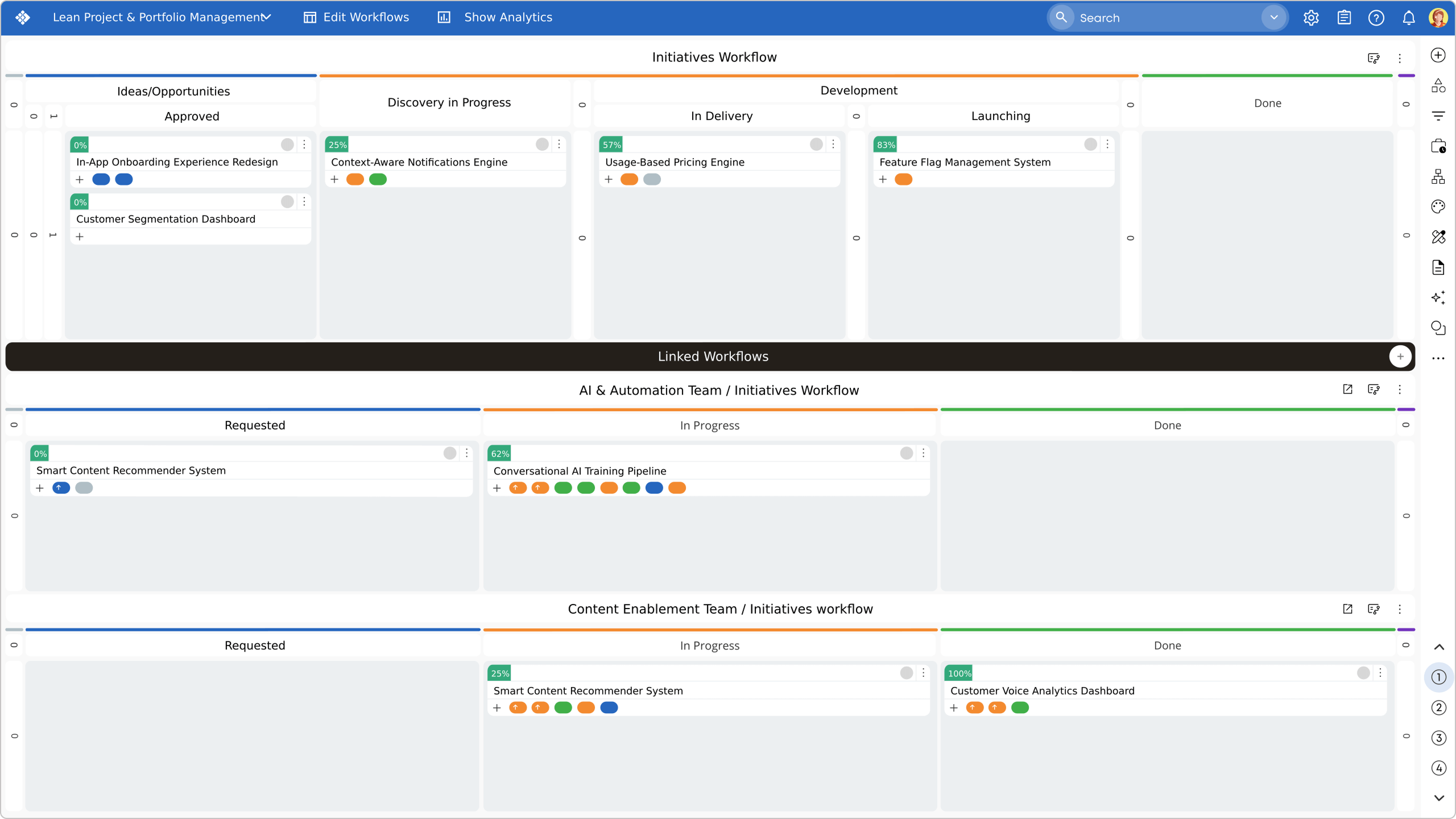 Connecting strategic and indivisual team boards in a single place in Businessmap
6. Automation Without Complexity
Automation should reduce friction, not introduce more tools. The best Kanban platforms provide built-in automation and policy-driven workflows that don't require scripting or add-ons.
7. Integrations & Ecosystem Fit
Kanban tools rarely operate alone. Strong integrations with the following solutions are essential for sustained adoption:
- Jira / Azure DevOps
- BI tools (Power BI, Tableau)
- Collaboration platforms (Teams, Slack)
- AI & automation tools
8. Ease of Adoption
A powerful Kanban system only works if teams actually use it. Evaluate:
- Learning curve
- Configuration effort
- Ongoing admin cost
Built on 15 Years of Kanban Practice: Businessmap as the Industry Benchmark
Businessmap is an enterprise-grade Agile Kanban platform developed in Europe, built on nearly 15 years of hands-on expertise to scale Kanban from teams to portfolios and entire organizations.
Unlike tools that simply visualize tasks, Businessmap is designed to govern flow, manage dependencies, and connect strategy to execution in complex, multi-project environments. It supports true Kanban practices out of the box, including explicit policies, WIP limits at every level, flow analytics, and forecasting without relying on plugins or third-party add-ons.
Why Businessmap Is the Reference Point for Agile Kanban
Built by Kanban practitioners, for real-world complexity
Businessmap's expertise in large-scale Kanban and flow management implementations shows in the product. Businessmap provides teams with the flexibility to work as they see fit, not the other way around.
Enterprise visibility without sacrificing team autonomy
Multi-level board hierarchies allow teams to operate independently while leadership gains real-time visibility into progress, risks, and dependencies across projects and portfolios.
Advanced flow analytics and predictability
Cycle time, throughput, WIP aging, flow efficiency, and delivery forecasting are native capabilities. In combination with AI powers, they offer real decision support, not just a way to track work.
"The Businessmap software helped us to measure and quantify data transparently, making it visually easier and more practical. We achieved a 33% improvement in our process – now understanding the flow and being able to focus on the heat map and define new strategies assertively and effectively."
— Pedro Iago Ferro da Silva Risco Bert, International Purchasing Coordinator at Encoparts Group
Automation and governance built in
Policy-driven automation ensures consistency and compliance across teams without creating administrative overhead.
European-built with proven trust and recognition
Developed in Europe and trusted by global enterprises, Businessmap is consistently recognized by independent analysts and users, including:
- Capterra Shortlist 2025 for Kanban Tools
- Capterra Shortlist 2026 for Workflow Management
- Capterra Shortlist 2026 for Task Management
- Capterra Shortlist 2026 for Project Management
Ready to see Businessmap in action?
Request your on-demand demoBest Kanban Board Software (2026) Overview
| Analytics & flow metrics | Automation | Scalability | Pricing / Trial | |
| Businessmap | Advanced (cycle time, lead time, throughput, WIP aging, forecasting, AI insights) | Extensive (rules-based automation, AI-assisted analytics, integrations) | Enterprise-grade (1,000+ users, multi-portfolio, global teams) | Subscription, predictable pricing, no feature-based add-ons; 14-day free trial |
| Asana | Limited (advanced insights gated by tier/add-ons) | Advanced (automation rules, tier-based) | Scales with admin overhead | Tier-based + add-ons; Free plan available |
| Wrike | Moderate (reports and dashboards, limited flow focus), real-time reports builder available to higher tiers | Advanced automations available to higher tiers | Enterprise-capable with configuration | Tier-based + add-ons; Free trial available |
| MeisterTask | Limited (basic reporting, AI prompts capped by tier) | Basic (recurring workflow tasks) | Team-level | Tier-based; Free trial available |
| Teamwork | Advanced (task and project reporting), Enterprise dashboards and Financial & Utilization Insights available with custom plans | Moderate (workflow automation actions per month from 5K-100K depending on the tier) |
Scales for services teams |
Tier-based; 30-day free trial |
| Teamhood | Moderate (flow metrics available, limited forecasting) | Moderate (conditions and triggers, from 700 to 7k runs/license for the yearly plans) | Mid-size teams | Subscription-based + add-ons; 14-day free trial |
| Flowlu |
Advanced (burndown charts, lead time, cycle time, custom dashboards, workload and sprint reporting) | Moderate (workflow automation, recurring tasks, business process automation) | Mid-size teams | Tiered, per-user pricing; 7-day free trial available |
Businessmap & Other Kanban Board Software Competitors
Businessmap vs. Asana: Enterprise Kanban vs. Task Boards
Businessmap delivers an effective Kanban system designed to manage flow across teams, projects, and portfolios by providing:
- Explicit process policies that make work rules clear and enforceable
- WIP limits at every level to prevent overload and improve flow
- Dependency visualization to expose cross-team and cross-project risks
- Advanced flow analytics, including cycle time, throughput, and forecasting, built directly into the platform and supported by AI capabilities.
Asana, by contrast, offers Kanban-style task boards primarily focused on individual teams and task coordination. While boards are visually intuitive, Asana lacks native WIP limits, flow efficiency metrics, and portfolio-level Kanban analytics. Many governance, compliance, and reporting needs require add-ons or higher-tier plans.
→ Check more Asana alternatives
Businessmap vs. Wrike: Flow-Based Kanban vs. Structured Task Management
Businessmap applies Kanban as a system-level execution model that connects strategy with delivery by enabling teams to:
- Visualize work end-to-end, from strategic initiatives to daily execution
- Define explicit process policies that guide consistent decision-making
- Control WIP to maintain focus and prevent overload
- Monitor delivery stability using real-time flow metrics
Wrike supports Kanban boards as one of several project views, mainly to visualize task progress within projects. Native flow analytics, probabilistic forecasting, and portfolio-wide Kanban governance are limited or unavailable without complex configuration.
Businessmap vs. MeisterTask: Enterprise Kanban vs. Team-Level Boards
Businessmap is built for enterprise Kanban adoption, supporting:
- Multi-level boards
- Cross-team dependencies
- Flow metrics that enable continuous improvement across portfolios.
MeisterTask focuses on simple, visual Kanban boards for small and mid-sized teams. It supports task automation and time tracking but does not provide advanced Kanban analytics, dependency mapping across teams, or portfolio-level flow visibility.
Businessmap vs. Teamwork: Portfolio Flow vs. Client Project Kanban
Businessmap enables Kanban workflows that span internal initiatives, cross-functional teams, and enterprise portfolios, with built-in flow governance and analytics.
Teamwork primarily uses Kanban boards for client project delivery and task tracking. While effective for managing external work, it lacks deep Kanban flow metrics, WIP enforcement across portfolios, and dependency visualization between teams.
Businessmap vs. Teamhood: Scaled Kanban & Agile vs Lightweight Kanban Task Tracking
Businessmap provides a full Kanban system enabling organizations to move from reactive execution to predictable delivery through:
- Explicit policies
- WIP limits
- Flow analytics
- Forecasting
- AI-assisted insights
Teamhood offers a lightweight Kanban experience suitable for small teams. While it supports visual boards and basic coordination, advanced analytics, portfolio-level flow tracking, and enterprise governance capabilities are limited or unavailable.
Ready to see Businessmap in action?

Iva Krasteva
Content Strategist | Agile Practitioner | Kanban Certified
Iva is a Kanban-certified Agile expert with hands-on experience in SEO, content creation, and Lean practices. She has published dozens of articles on Lean, Agile, and Kanban practical applications. Iva actively promotes collaborative, flexible work environments and regularly shares process optimization insights through writing.